Design Philology Essays. Issue Zero. Design at Politecnico di Milano: The Beginning of a Story

edited by Paola Bertola, Giampiero Bosoni, Agnese Rebaglio

The image is an abstract graphic background featuring a sandy beige or light taupe gradient. The composition follows the minimalist style of the series, showcasing blurred circular shapes of different sizes that gently overlap. The design is clean, warm, and professional, ideal for contexts requiring a neutral, relaxing, and elegant aesthetic.

This new editorial initiative is dedicated to celebrating the historical and cultural roots of design at the Politecnico di Milano.
This collective volume inaugurates the initiative, which is focused on the historical memory and cultural roots of the Design System at the Politecnico di Milano. The initiative aims to sustain the distinctive design and innovative spirit that characterises polytechnic culture.Through eleven essays, Design Philology Essays. Issue Zero retraces the origins and evolution of design at the Politecnico, beginning with the establishment of the first Bachelor's Degree Programme in Industrial Design in Italy in 1993.

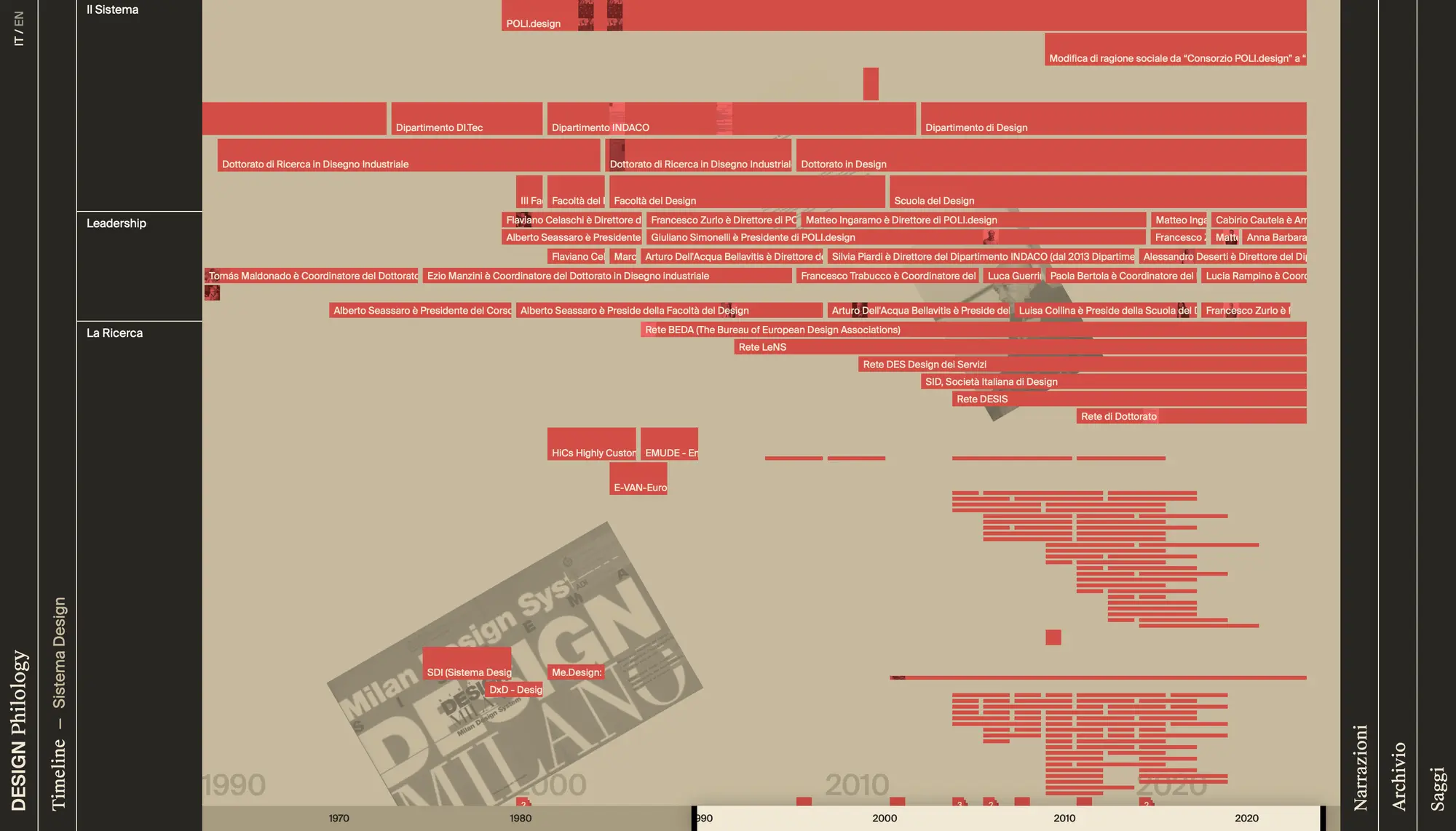
This set of images illustrates a methodological journey related to strategic design and academic research. It opens with a collage of participatory workshops showing the use of inspirational mood boards and territorial maps to actively involve the community in the design of public services and spaces. This operational phase is supported by in-depth theoretical analysis, represented by a complex infographic timeline titled "Design Philology" that reconstructs the evolution of the Milanese design system, tracking leadership, university departments, and research trends from the 1990s to the present. The entire process is framed by a consistent visual identity, exemplified by a minimalist powder blue graphic background with abstract geometric shapes that evoke concepts of connection and systematic design.
Timeline, Design Philology platform. Image taken from the essay 'From archives to narratives: a digital platform for the representation of design heritage' by Marco Quaggiotto and Arianna Priori.

The book is divided into two sections. The first section explores how digital humanities can enhance the historical heritage of design through digital archives, editorial platforms and interactive tools that can create multimedia and hypertextual narratives.

The second section brings together contributions that recount the institutionalisation of the Design System within the Politecnico di Milano through the establishment of the Faculty of Design (now the School of Design), the Department of Design and the POLI.design Consortium.
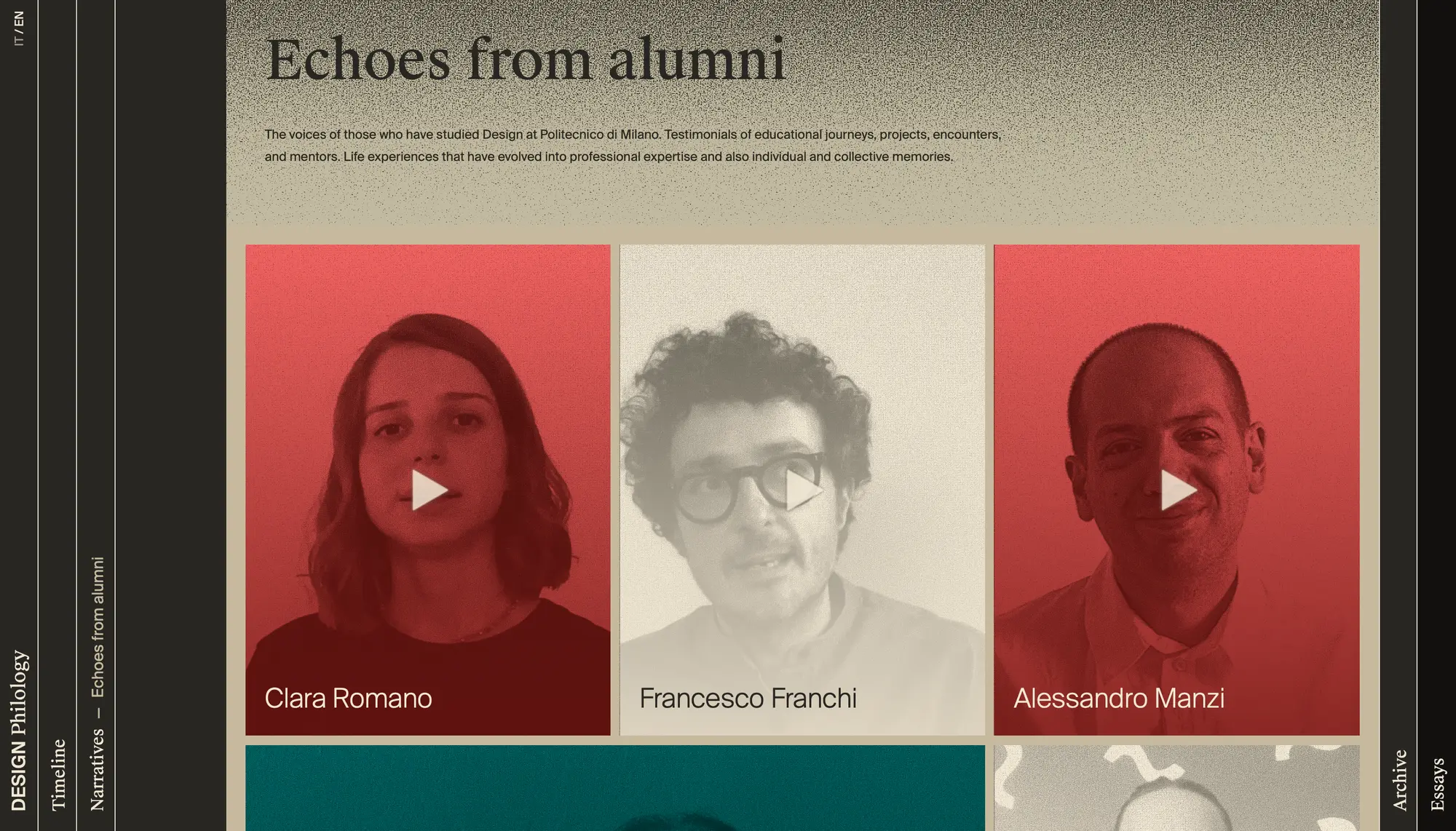
The final image is a screen capture from the "Design Philology" project titled "Echoes from alumni." It features three video testimonials from Politecnico di Milano alumni—Clara Romano, Francesco Franchi, and Alessandro Manzi—whose faces are shown in close-up with a reddish filter. The graphics are clean and institutional, characterized by a grid layout on a grainy sand-colored background, enhanced by white "play" icons overlaid on the portraits to indicate multimedia content.
Echoes from alumni, Design Philology platform. Image taken from the essay 'Designing Designers' by Anna Meroni and Andrea Manciaracina.

This volume is intended as a starting point for designers, researchers and students who are interested in understanding the historical and cultural foundations of design at the Politecnico, and who wish to reflect on how these foundations can inform the future of the discipline in response to today's cultural, social, technological and environmental challenges. Design Philology Essays. Issue Zero is available on Design Philology platform and in FrancoAngeli open access catalog.

Share on: