Design “within walls”

Storytelling as an action-research practice in marginal contexts

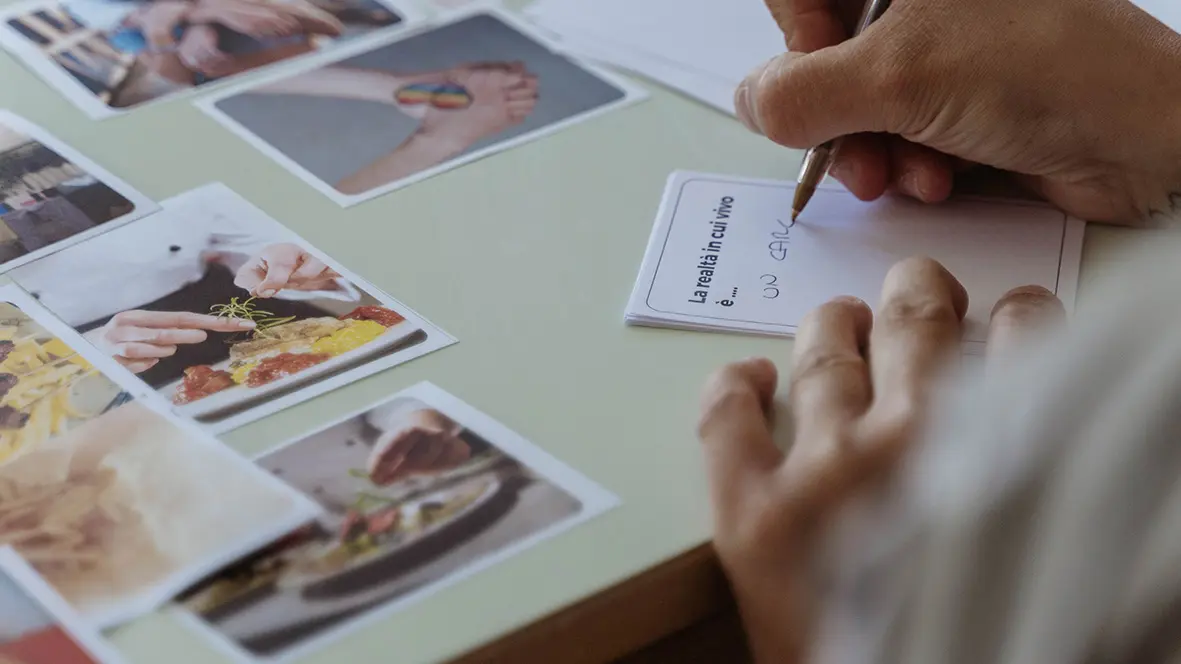
The last image ideally concludes the design process, showing direct user involvement through an activity of reflection and co-creation. In a close-up shot, a hand writes on a small white card that says: "The reality I live in is...". Several photographs are scattered on the table, depicting hands engaged in various activities: from cooking to holding hands (one of which shows a small rainbow heart). This scene suggests a participatory design workshop or a therapeutic session, where images serve as visual prompts to help individuals express their feelings and worldview. The natural light and soft tones emphasize the intimacy and significance of this moment of personal expression.

The status of Italian penitentiaries represents a civil emergency which, in spite of the evolution of the country’s legal system and the daily dedication of the jail administration and the third sector actors, has yet to produce any effective answer.

Since 2020, the Imagis Lab research group is conducting action-research activities within the Italian penitentiaries, testing the role of communication design as a process of relationship, and of storytelling as a co-design practice.

Within this framework operates ACTS – A Chance Through Sport, an action-research project made possible by the Polisocial Award 2019 contribution, centered on sport as an instrument for social inclusion in detention sites, with the purpose of overcoming the commonly held belief that sport activity within penitentiaries represents nothing more than a pastime, and that the period of detention should be intended as a period of punishment. This research, in fact, explored the theme of sport as a physical reeducation practice for people, the definition of a relational sphere based upon shared rules and mutual respect, and the opportunity to rethink detention sites in order to make them suitable for individual and group sport activities, while taking care of the aesthetic quality of such places.
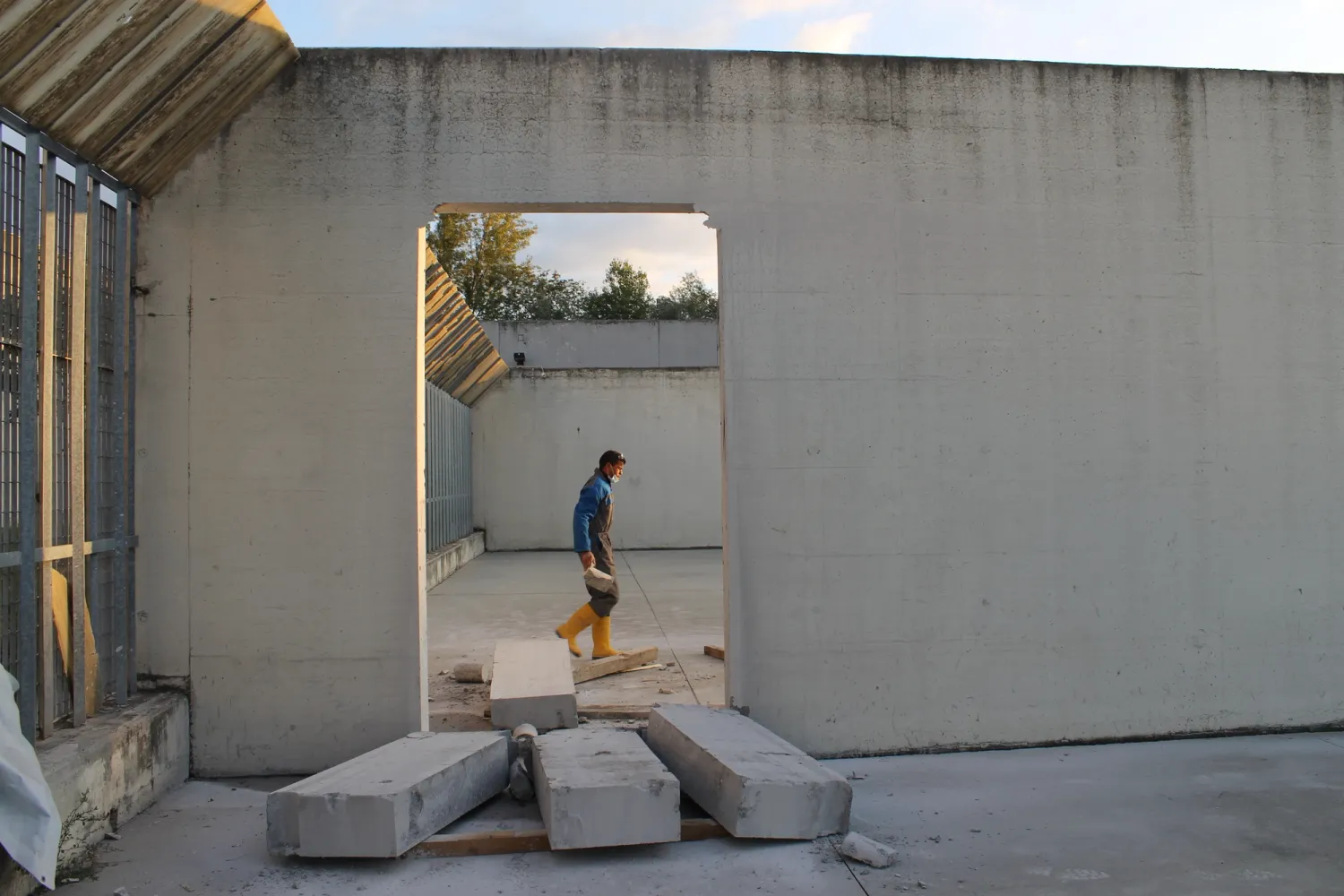
The image captures a moment of work at a construction site or an industrial area, characterized by rigid geometries and warm natural lighting. Framed through the rectangular opening of a tall concrete wall, a male figure is seen walking inside a bare courtyard. The man wears blue overalls and bright yellow rubber boots, which create a strong color contrast with the grey tones of the concrete. On the ground in the foreground lie several concrete blocks, either removed or ready for installation. To the left, a metal fence with an angled roof defines the space, while in the background, treetops rise beneath a hazy sunset sky. The composition conveys a sense of solitude and architectural precision.

Between March 2020 and March 2022, the research analyzed the spaces of the Milanese detention sites, leading to the creation of some experimentations in the Milanese penitentiary in Bollate. Such a work was carried out, in a multi-disciplinary fashion, by three different departments: the Department Of Architecture and Urban Studies, investigating practices and spaces, and planning ameliorative strategies; the Department Of Design, performing activities of co-design of narrations, producing multi-media contents and developing a communication plan to connect the inside and outside world; the Department of Electronics, Information and Bioengineering, involved in physio-motorial studies and in determining training protocols.

The study on detention sites revealed that such places possess unexpected design potential, both in terms of people and places, and that, in such contexts, design can represent a tool to activate listening, communication and integration processes within the slow and complex dynamics of penitentiaries.

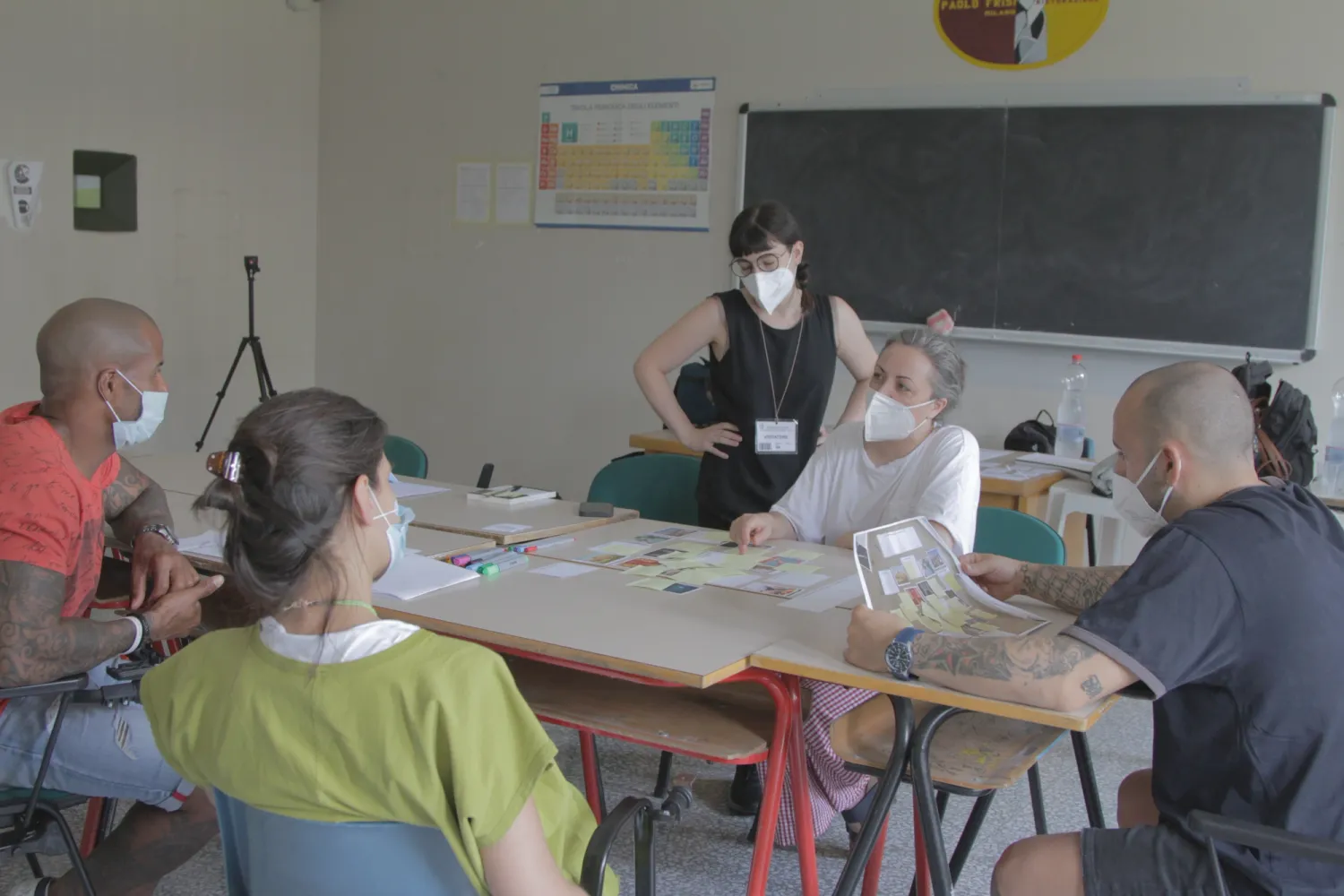
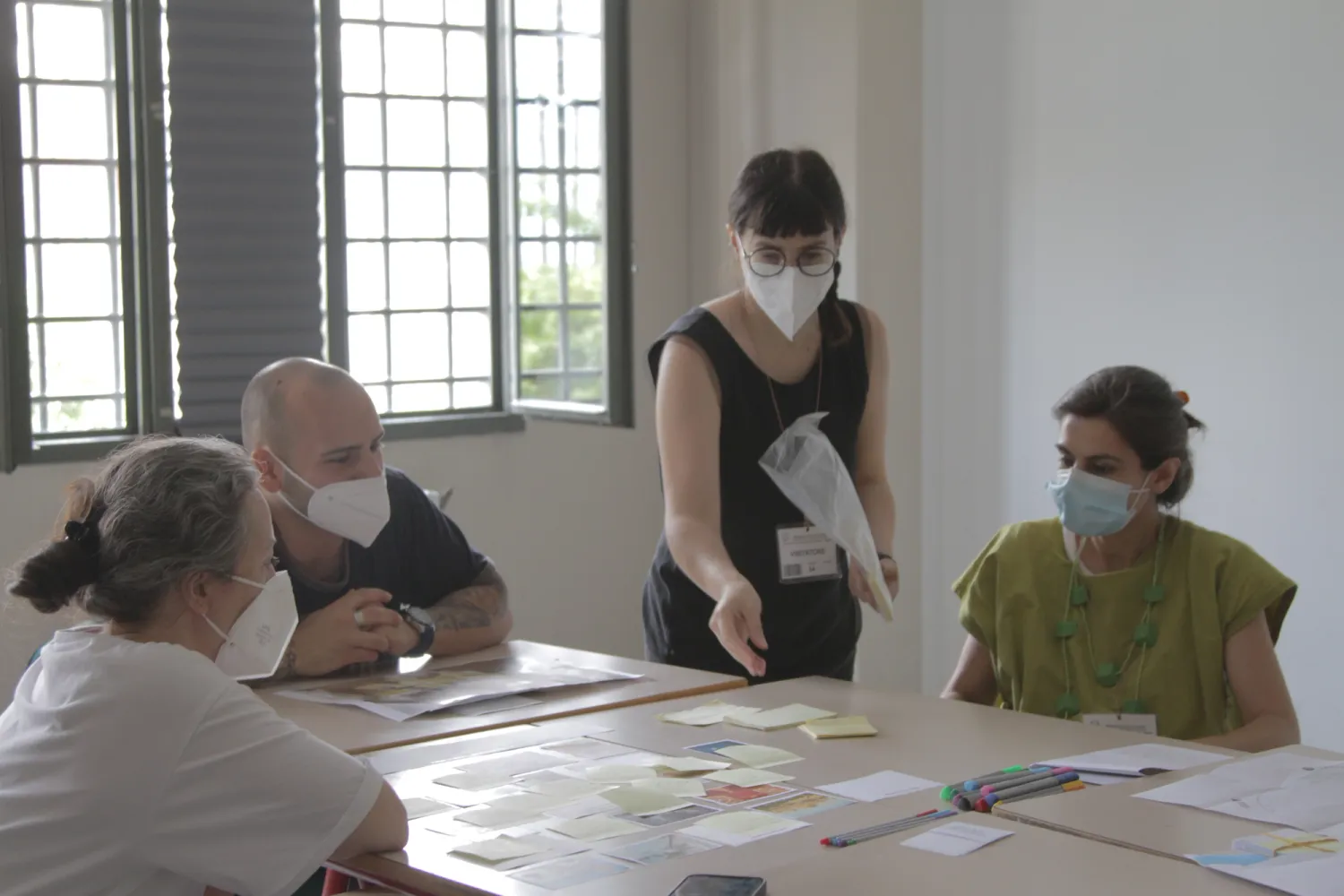
The image depicts a moment of active collaboration during a workshop or co-design session, with a focused and methodical atmosphere. Four people are gathered around a worktable covered with brainstorming materials, including post-its, photographs, and colored markers. A woman standing in the center appears to be facilitating the discussion, pointing to the items arranged on the table, while the other three participants listen intently. Everyone is wearing protective face masks, suggesting the meeting took place during a period of health precautions. Natural light from the large barred window in the background illuminates the scene, highlighting the exchange of ideas and the group's creative process in a minimalist and professional setting.
The image documents a subsequent or complementary phase of the co-design workshop, maintaining the same spirit of collaboration and analysis. In a classroom or laboratory setting, the same working group continues their brainstorming activity around a table. A woman in a white shirt points to a specific spot on a series of cards and photographs arranged in the center, while a man to her left examines a printed project board. The facilitator in black oversees the discussion with her hands on her hips, in a pose of active listening. In the background, a chalkboard and a periodic table of elements hanging on the wall suggest the meeting is taking place in an educational environment. The presence of face masks and the use of physical materials highlight the importance of direct human interaction in the social design process.

The research, carried out in close connection with the whole penitentiary administration hierarchy, and with prison wardens, also engaged the School of Design students, as well as artists and professional designers. In addition to the audio-visual documentation of the collaborative work that was carried out, the research was carried out through a collaborative narration process. Indeed, actions and tools have been designed to support the re-construction of individual and collective identities.

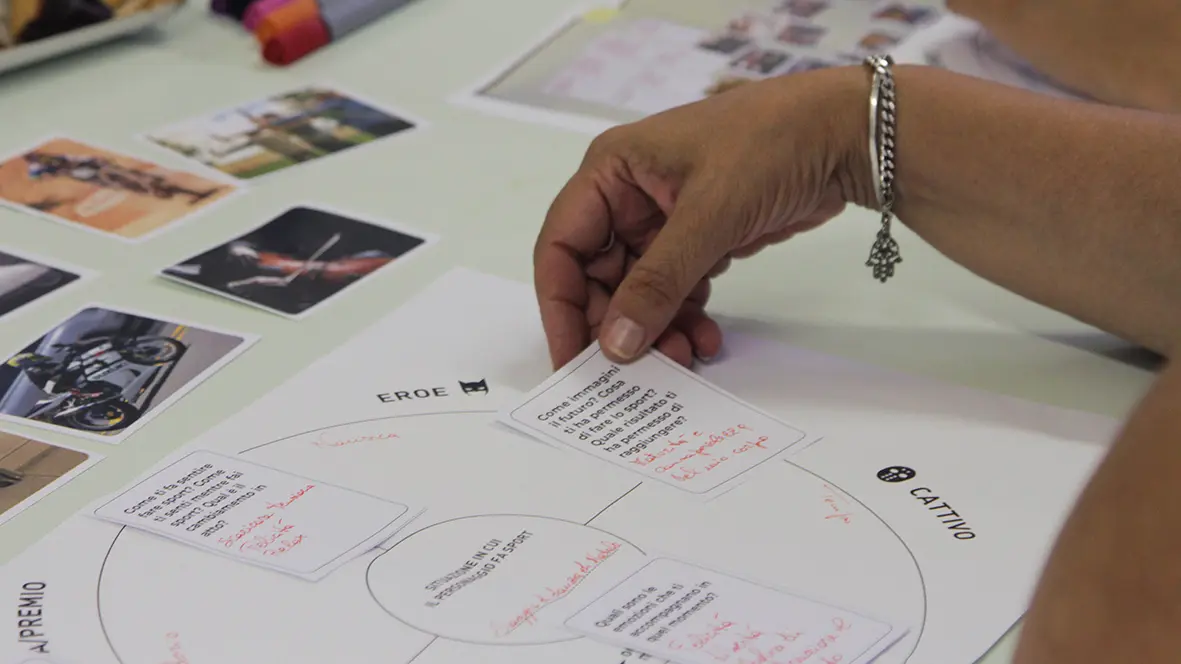
On the basis of the Narrative-based Design Framework developed by the Imagis Lab, participants were provided with expressive tools, useful to support creative processes. In this regard, the creation of a character became the starting point for writing and sharing their own experiences and viewpoints with others, for the purpose of putting themselves in somebody else’s shoes or even re-imagining themselves, re-building their own identity beyond their past and their present-time condition of punishment.

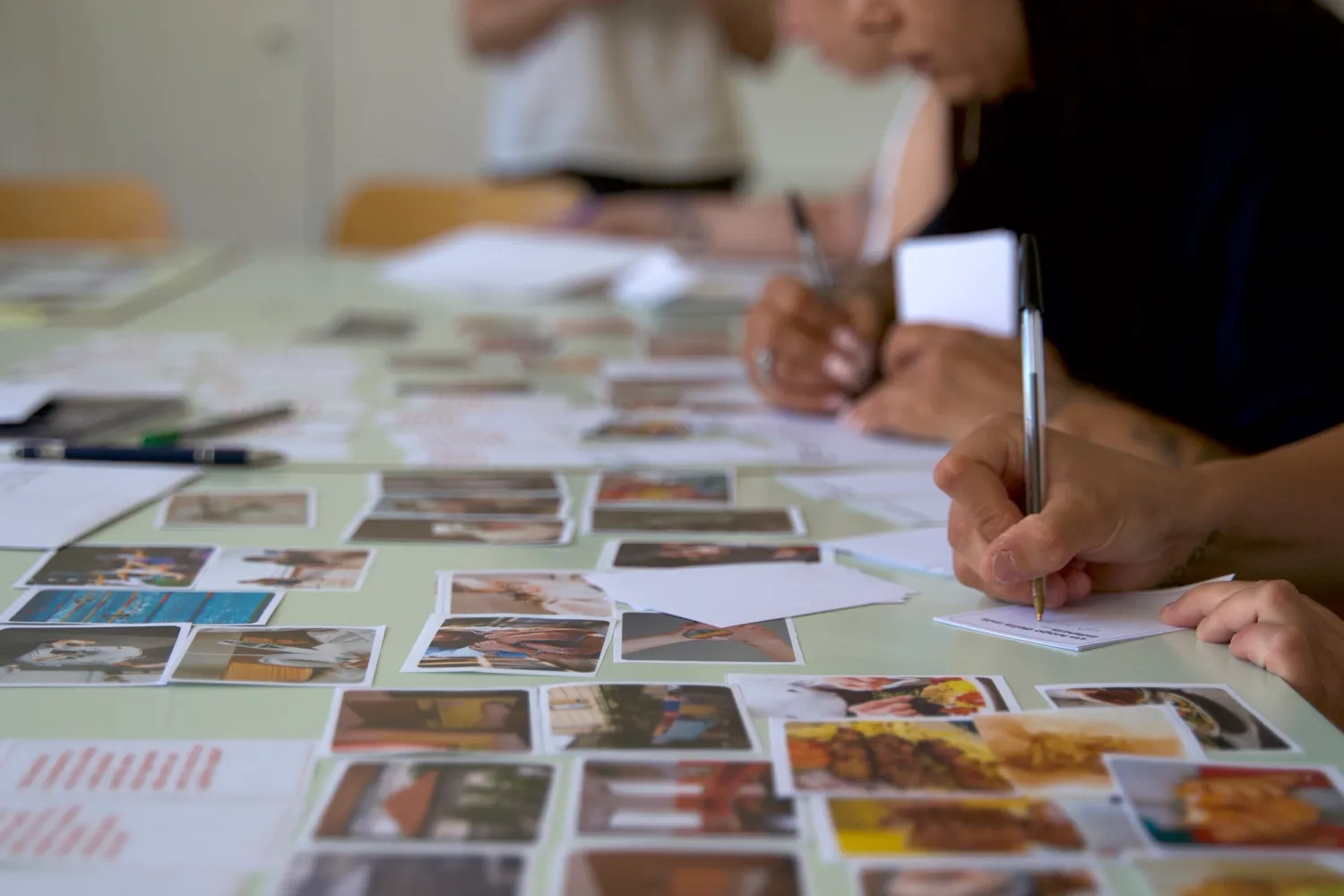
The image captures a moment of intense collective participation during a participatory design session, focusing on the interaction between people and their working tools. In the foreground, several hands are captured writing on small white cards, surrounded by a spread of stimulus photographs scattered across a large worktable. The images depict scenes of daily life, object details, and human interactions, likely serving as a basis for an association or reflection exercise. The shallow depth of field emphasizes the act of writing, while the presence of other participants engaged in the same activity is felt in the background. The atmosphere suggests a process of listening and translating thoughts into concrete concepts, a cornerstone of inclusive design.
The image shows a close-up detail of an analysis and reflection activity, likely part of a storytelling or therapeutic design workshop. A hand, adorned with a bracelet featuring the "Hamsa" symbol, is placing a small card onto a structured methodological sheet. The sheet features concentric circles with labels such as "HERO" and "VILLAIN", suggesting the use of narrative archetypes to explore personal experiences. Various photographs and small text snippets are visible on the table, posing profound questions like "How do you imagine the future?" or reflections on sports and emotions. The composition suggests a process of breaking down lived reality through play and storytelling, facilitating the communication of complex concepts in a visual and tactile way.

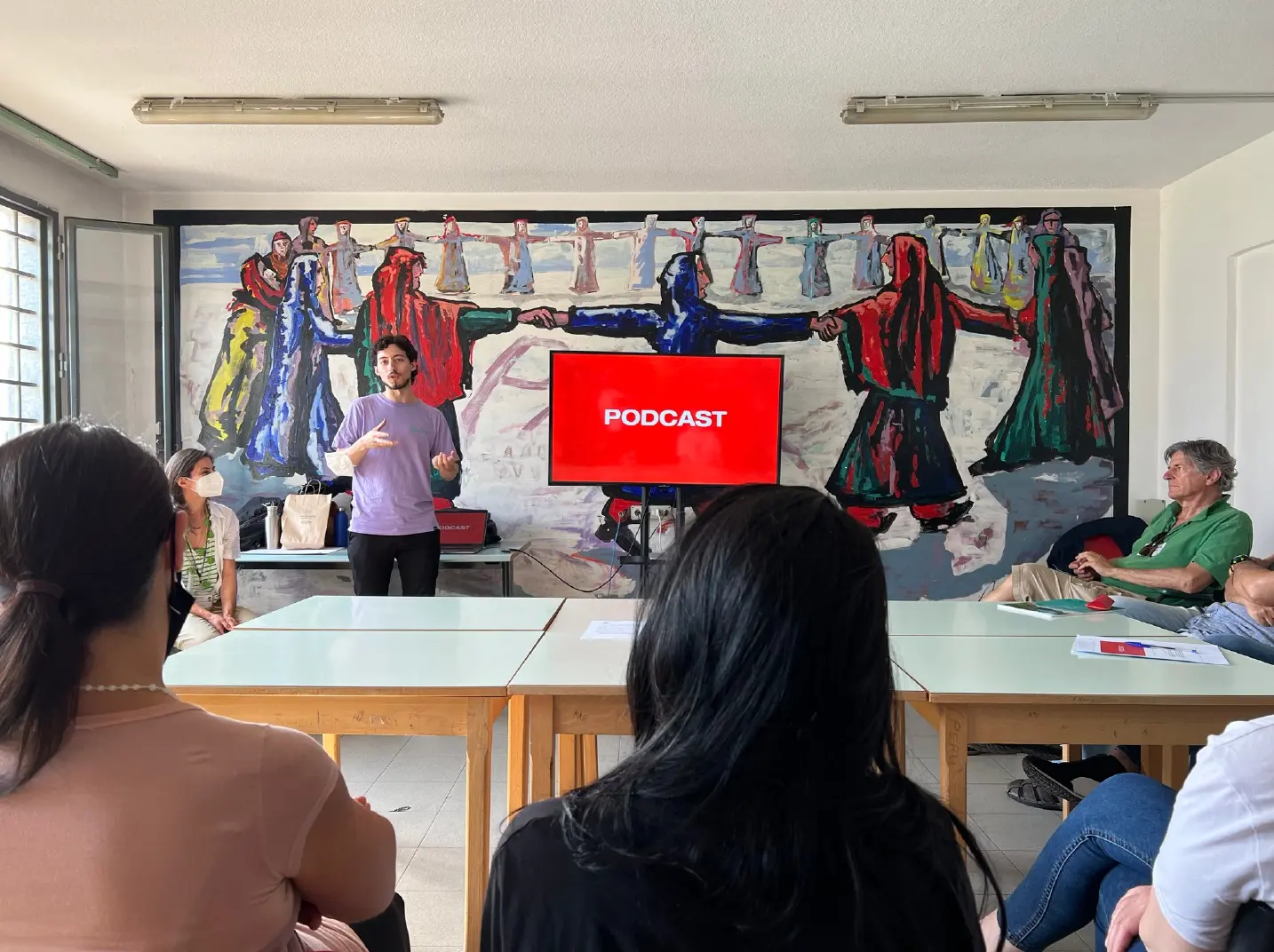
The outputs of the collaborative storytelling activities gave birth to a documentary titled ACTS. A Chance Through Sports, and to a podcast series titled Tra le mura, written by the detainees during the lab.

The documentary and the pilot episode of the podcast series were released and made available at the Project Room of the Contemporary Art Pavilion (PAC) in Milan from October 9, 2022 to November 6, 2022, as part of the Laboratorio Carcere exhibition, centered around the research carried out by the Politecnico di Milano within the Milanese penitentiaries since 2014.

The image captures a presentation or group meeting focused on digital communication and storytelling, set in an environment enriched by significant artistic elements. A young speaker in a lilac t-shirt addresses a seated audience, gesturing to emphasize his points. In the center of the room, a bright red screen displays the word "PODCAST" in white, clearly indicating the session's topic. The background is dominated by a large, colorful mural depicting a row of stylized human figures holding hands, evoking themes of unity and community. Participants are arranged around wooden tables set in a horseshoe shape, creating an informal and participatory atmosphere. The natural light entering from the side and the furniture arrangement suggest a social or educational workshop context.

The expertise gained with the ACTS research led to the opening of Off-Campus San Vittore (October 2022), the third space promoted by Polisocial to strengthen the Politecnico presence in the Milanese territory, with the purpose of acquiring new knowledge on detention sites as well as to bring the city and the penitentiary closer to each other.

In continuity with the multi-disciplinary approach, the architecture and the design teams carry on their cooperation and the opening of Off-Campus San Vittore is paving the way to identifying new cooperation possibilities between the research and penitentiary worlds, in direct relationship with Milanese and Italian realities.

Thanks to Off Campus San Vittore, the impact of the ACTS project is destined to further grow in the coming years, involving a growing number of beneficiaries and stakeholders in its activities: the desire is to create a permanent laboratory, whose ultimate goal is to effectively strengthen and finalize the dialogue between the “inside” and the “outside”, enhancing their mutual opportunities.

TEAM

Project Coordinator:
Francesca Piredda – Associate Professor

Research group members:
Mariana Ciancia – Senior Researcher
Davide Fassi – Associate Professor
Chiara Ligi – Research fellow
Anca Serbanescu – PhD student

Collaborators:
Paolo Benvenuti – Sound engineer, audio filming
Alberto Danelli – Videomaker, video shooting, editing and directing
Anastasia Dell’Oro – Service designer, intern and thesis student
Andrea Folini – Communication designer, thesis student
Chiara Gambarana – Service designer, listening
Kevinn Genovese – Communication design student, video shooting
Claudia Massimi – Service designer trainee, listening
Davide Pinardi – Author, collaborative writing
Tommaso Ripani – Communication design student, video shooting
Martina Rosa – Videomaker, video shooting, editing and directing
Massimiliano Santillo – Sound engineer, audio filming
Max Viale – Musician and sound designer, sound filming and sound design

Share on: