The Bridge of Future

Bridges of the future for the Seoul Architecture and Urbanism Biennale 2023

The image shows the interior of an auditorium during an academic conference. On stage, three speakers are seated at a white table, engaged in discussion and interacting with the audience. One of them holds a microphone, suggesting a Q&A session or an active debate. The setting is characterized by large, multi-paned windows that let in natural light, creating a professional atmosphere open to the exchange of ideas.

Two futuristic inhabited bridge projects, created during the School of Design's New Interiors Workshop "FUTURABILITY: Timeless Utopias for Seoul," placed among the 12 finalists to participate in one of Asia's largest international architecture exhibitions.

Starting from September 1st, 2023 and throughout October, two projects by students from the School of Design at Politecnico di Milano will be exhibited at the Seoul Biennale of Architecture and Urbanism.
The projects were created during the New Interiors 2 Lab of the Master's Degree Course in Interior and Spatial Design by Professors Ico Migliore, co-founder of Migliore+Servetto Design Studio, and Paolo Giacomazzi, with Rossella Forioli and Viola Incerti.

The course, in line with the Cultural Proximity program that Migliore+Servetto Design Studio is involved with, focuses on developing cutting-edge visions related to urban cultural redevelopment.

This year's theme, “Futurability: Timeless Utopias for Seoul”, allowed students to try their hand at developing visionary designs of inhabited bridges over the Han River designed for the future of the city of Seoul.
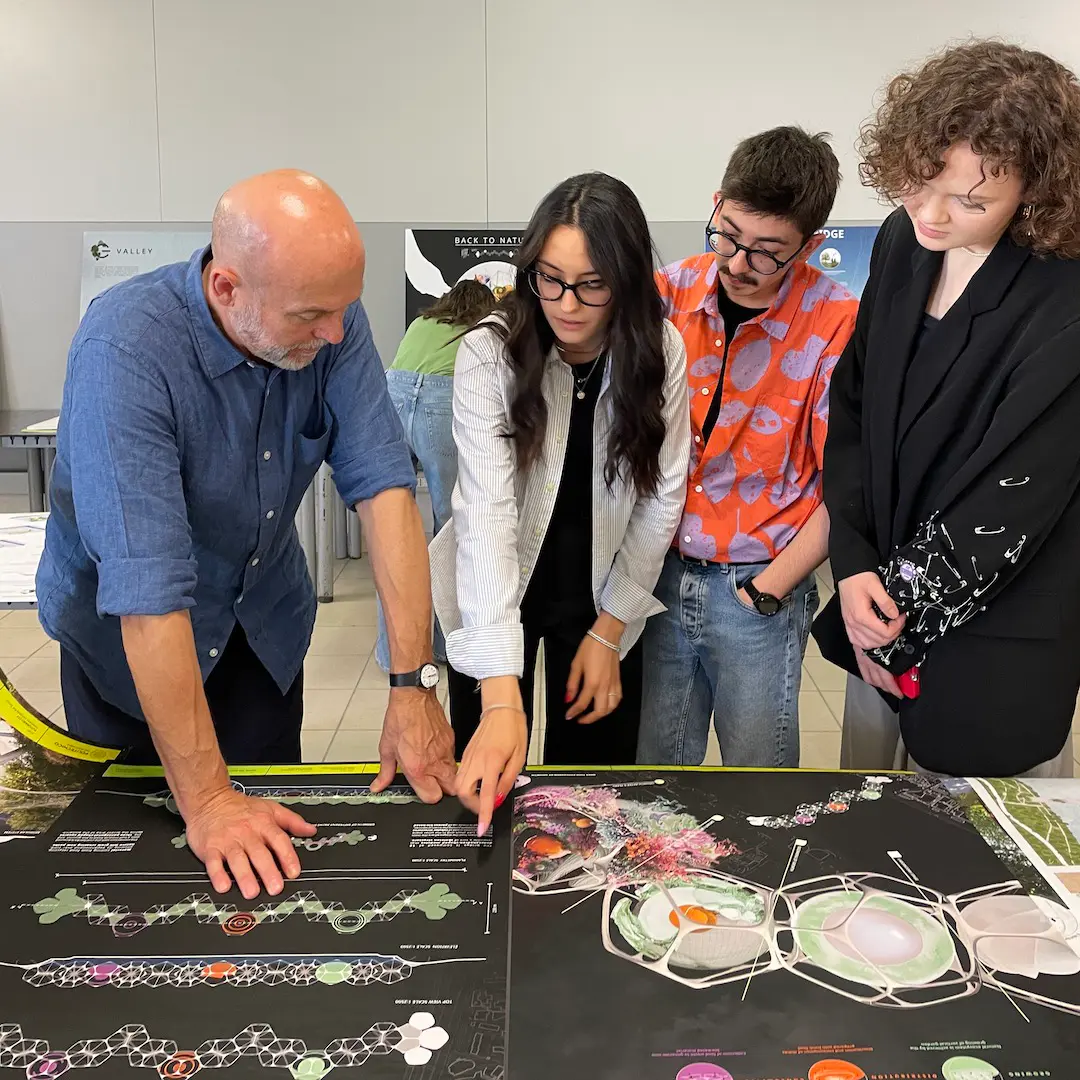
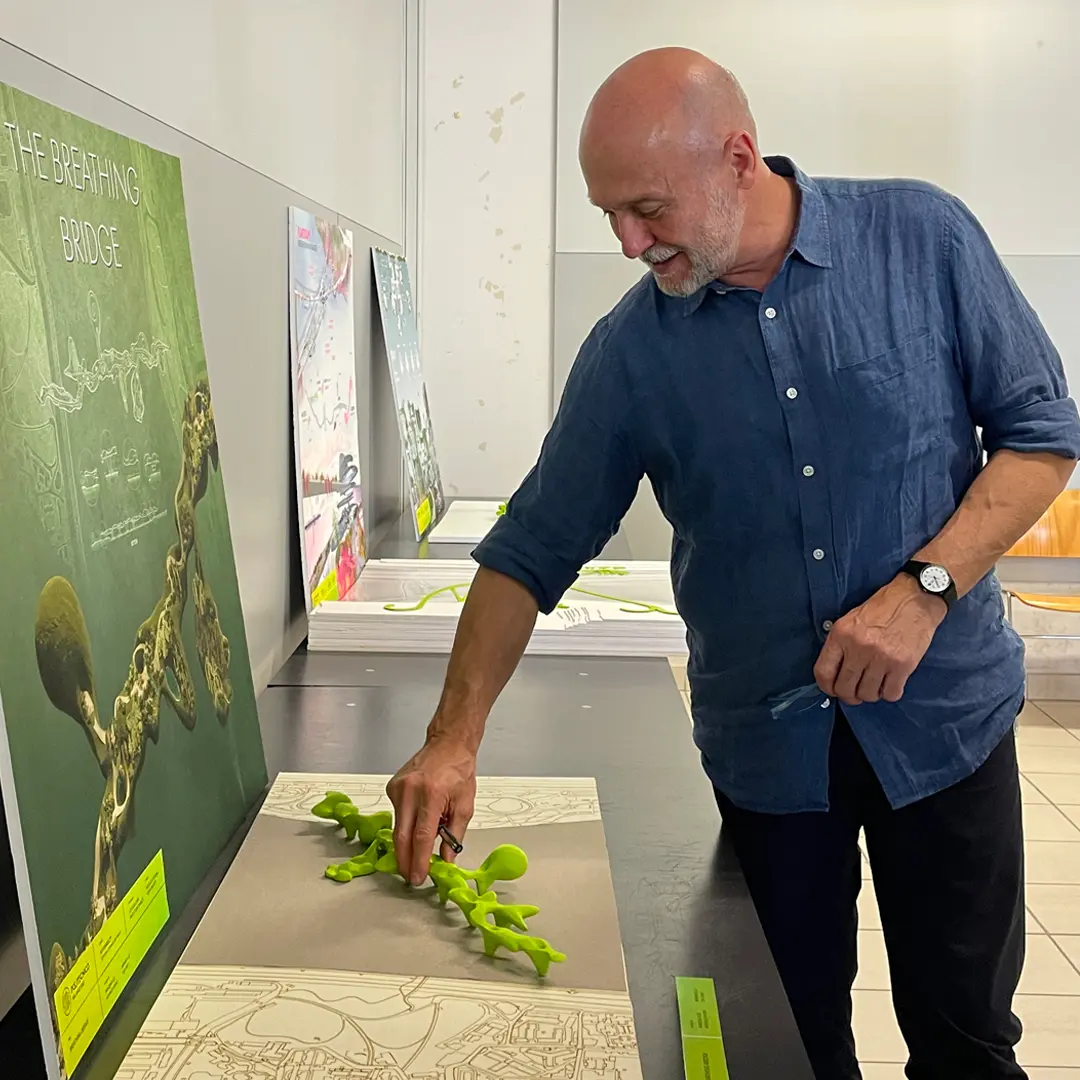
The image captures a moment of academic or professional review between a professor and a group of young researchers or students. At the center of the scene, a man and three students are gathered around a table covered with large design boards. One of the students points to a technical detail on a black panel filled with colorful schemes and diagrams, while the professor, on the left in a blue shirt, observes closely. The designs involve complex, biomimetic architectural structures, with renderings showing organic and cellular shapes. The atmosphere is one of dynamic and collaborative intellectual exchange, typical of a design studio.
The man, wearing a dark blue shirt, is leaning over a table where a bright green organic and branched prototype is placed, part of the "The Breathing Bridge" project. In the background, several academic posters and information boards are visible, illustrating the architectural concept characterized by fluid and natural shapes. The setting suggests a design review phase or a research presentation related to sustainable and biomimetic design.

The theme of the fourth edition of the Biennale, directed by Architect Byoung Soo Cho, is to investigate the future of Seoul in 100 years, imagining a green and sustainable city to reconnect the urban fabric and its inhabitants with nature. The "Global Studios" section of the Biennale involved around 40 universities from all over the world, gathering the participation of more than 500 students and a hundred professors of Architecture and Design.

The vision of a future based on the synergy of man, architecture and nature was thus identified as the cornerstone of the entire design course of the School of Design.

«Architectures are spaces in motion and in balance, always in constant metamorphosis. Living organisms in dialogue with humans, Artificial Intelligence and nature.»

THE BREATHING BRIDGE

The Breathing Bridge project is inspired by the concept of breathing, an act of exchange of energy between living organisms and the atmosphere. The bridge is conceived as an organic living being that retains, processes and transforms “Gi”, the source energy of life, to gradually adapt to its environment as naturally as breathing. The exchange process involves the bridge, its inhabitants and the environment: through the bridge, citizens breathe in the mountains, hills and water of Seoul, whose energy is retained to be processed and transformed by human activity; the exhalation of “Gi” connects with nature to provide new energy and air.

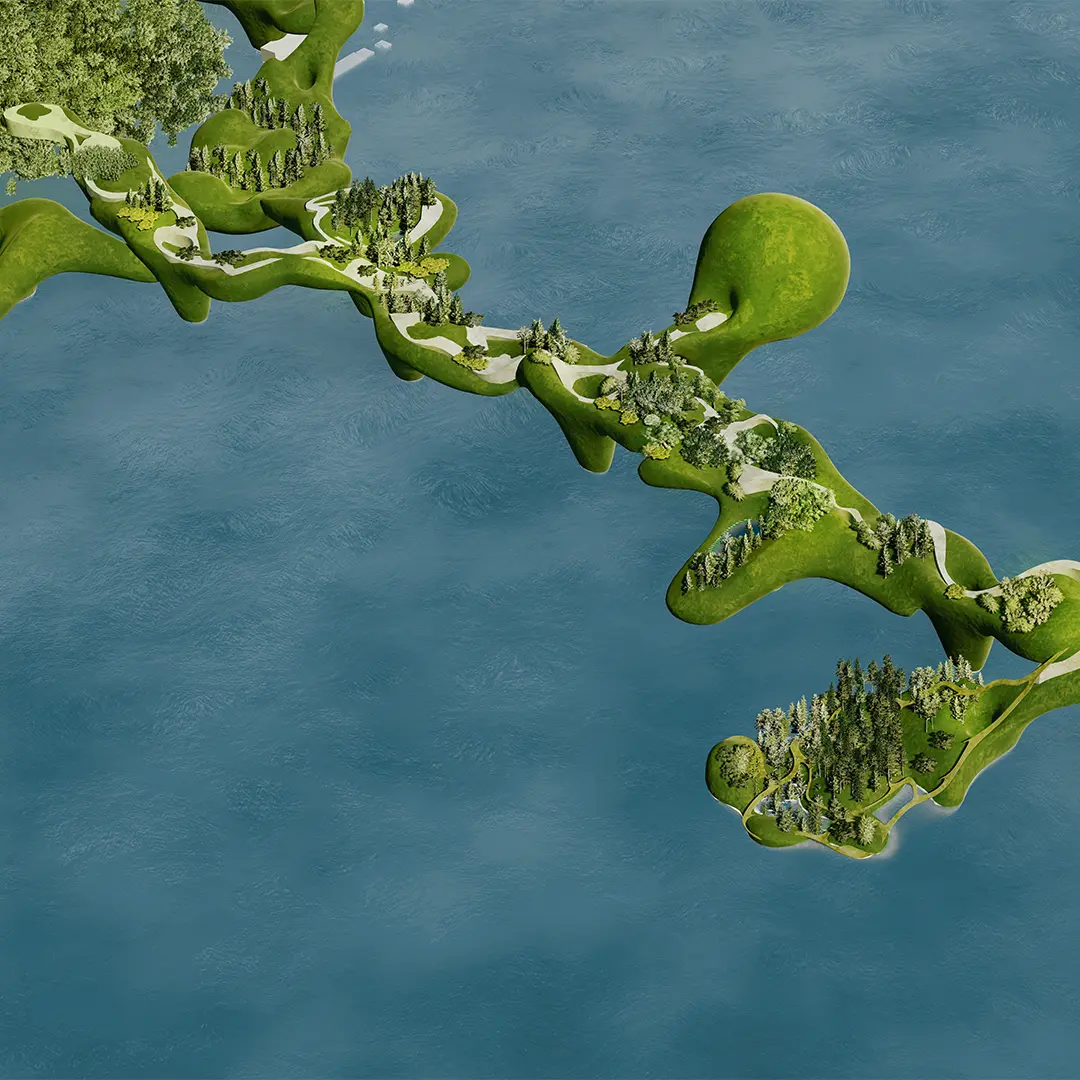
The image represents "The Bridge," a structure whose organic shapes and curves are inspired by the natural landscapes of South Korea, consisting of four versatile functional modules capable of floating or resting on land. The project is developed across two levels, featuring a surface area dedicated to fitness and outdoor activities designed to host festivals, performances, and hologram installations, while the internal galleries provide a protected space with filtered and clean air, ideal for relaxation, social interaction, and immersive entertainment through holographic games and shows.

The bridge, whose shapes and curves are inspired by the natural landscapes of South Korea, consists of four functional modules that can be combined to float or rest on land. There are two levels:

On the ground, citizens can exercise and engage in outdoor activities by participating in festivals, entertainment shows and organised holograms;

In the indoor galleries, citizens can relax in a filtered and clean environment, interact or watch shows or play games through the holograms.

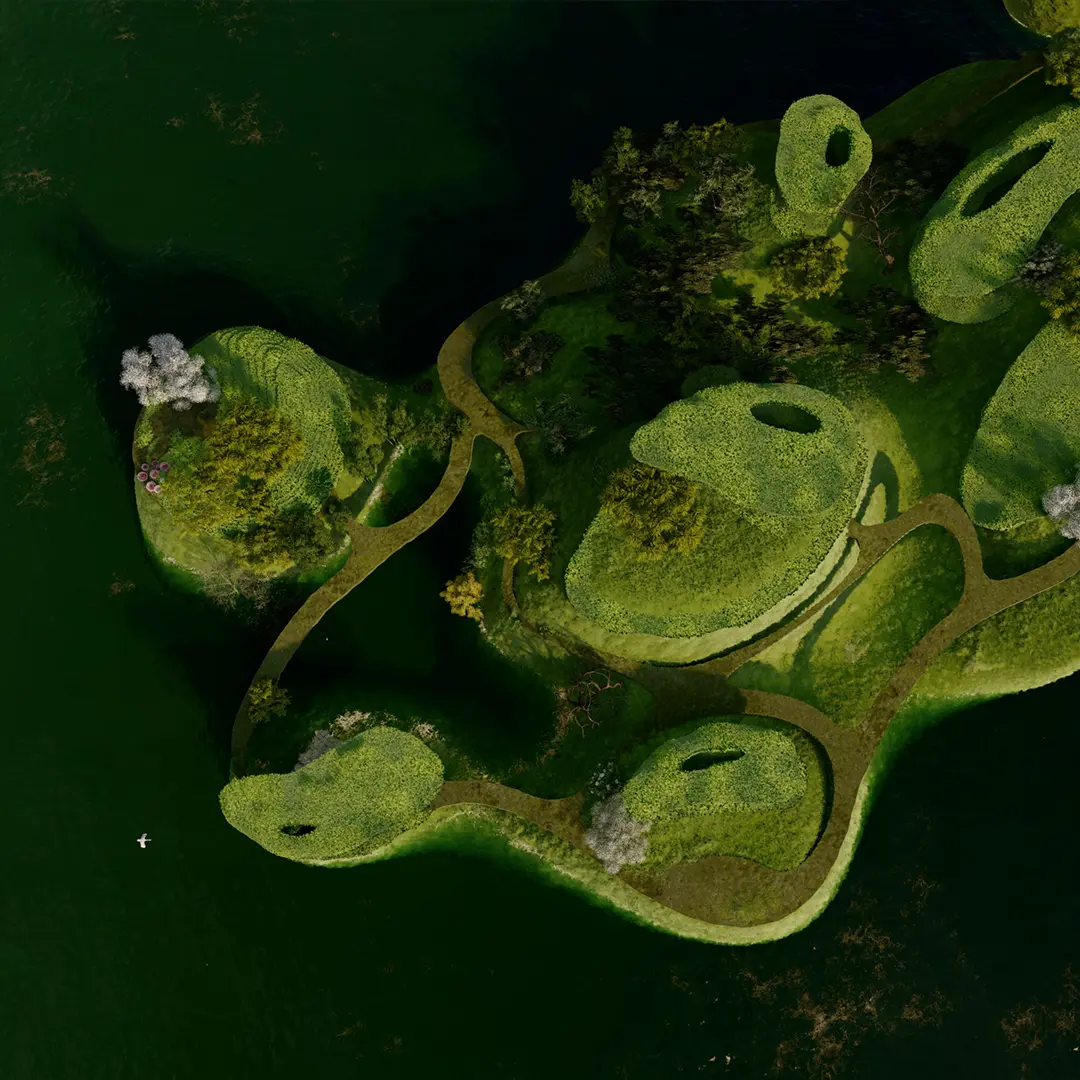
The image shows an aerial view of an imaginary and utopian environment, designed as a sustainable and harmonious living ecosystem. The structure appears as a collection of green islands or platforms with organic shapes, connected by winding paths crossing a dark body of water. The "dwellings" are integrated into the landscape, appearing as grassy mounds with circular openings serving as skylights or entrances, dotted with flowering trees and wooded areas. The entire concept evokes a future where architecture and nature merge completely in a biophilic design.
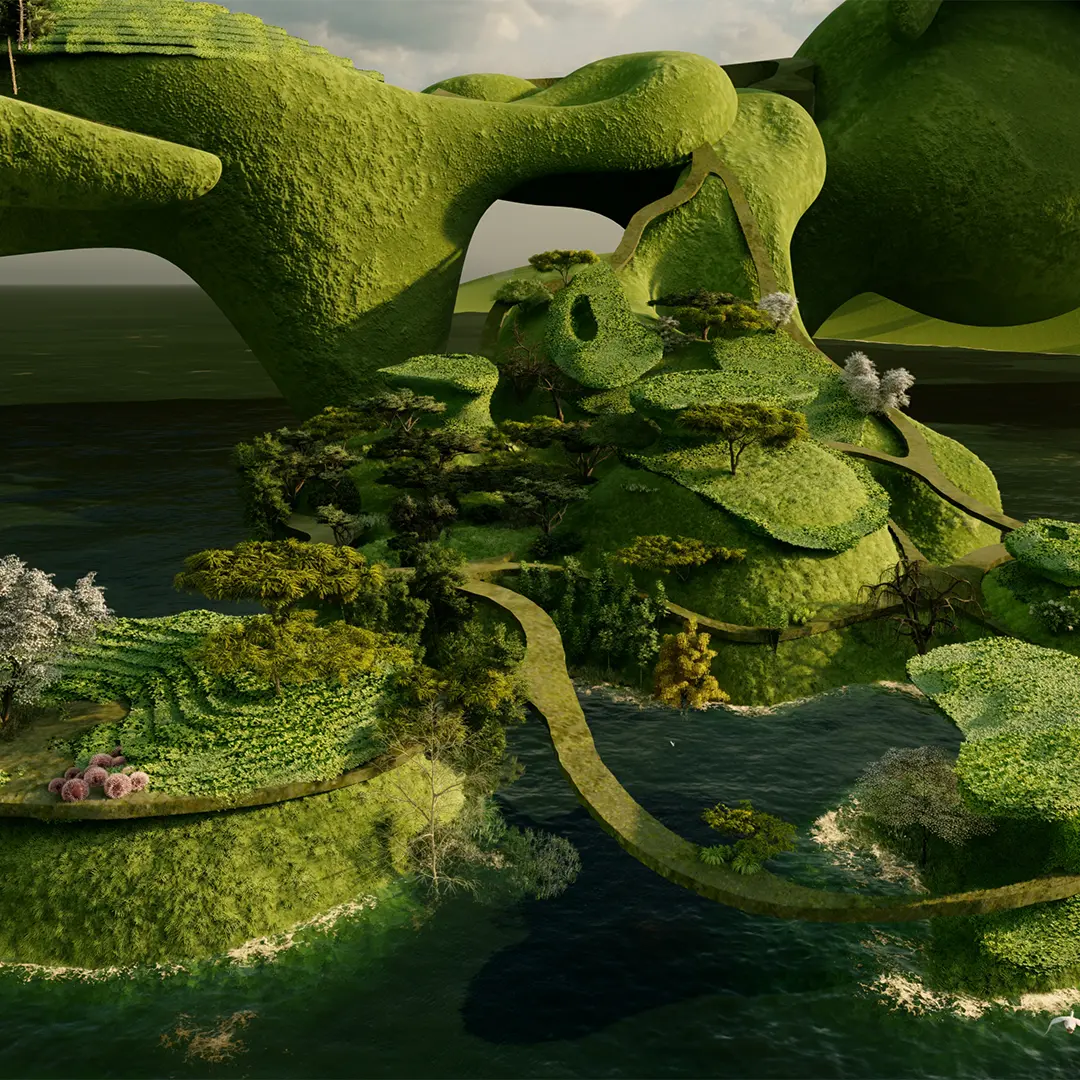
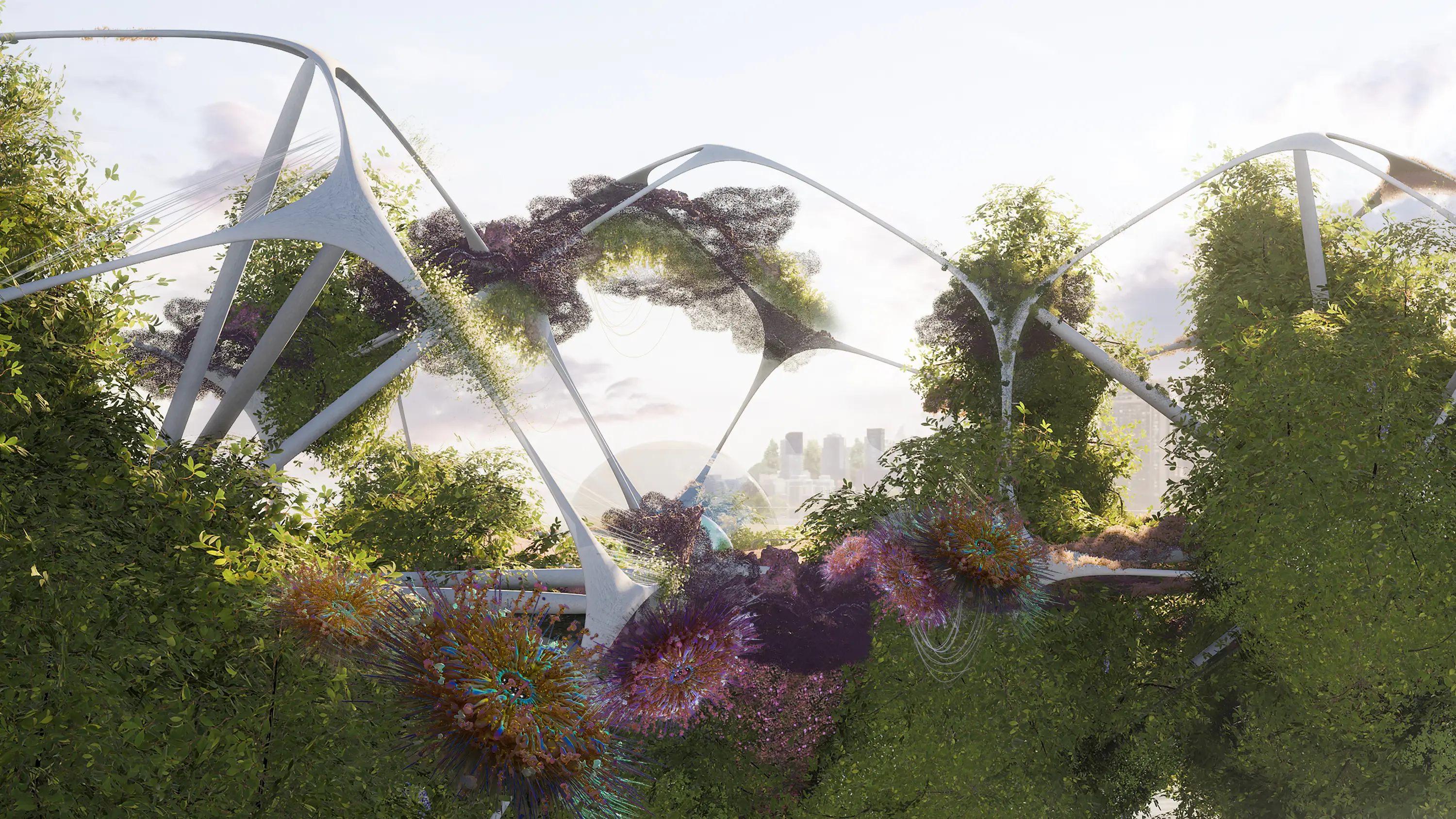
The image shows a close-up perspective of a futuristic architectural and landscape environment, part of "The Bridge" project. The scene is dominated by massive green structures with organic and sculptural shapes that rise above a body of water, creating natural bridges and terraces. Winding paths connect various platforms covered in lush vegetation, flowering trees, and small gardens, outlining an urban oasis where construction technology perfectly blends with the natural environment.

Each module consists of a membrane made of a multi-layered futuristic skin, a work of bio-engineering capable of modifying its properties. This feature allows continuous transformation and replacement of the modules. The membrane is able to filter out certain pollutants and sunlight, retain heat to release it at night, and has mechanical properties due to the nerve layer that shrinks and expands to connect. The skin expands when the climate and atmosphere are unhealthy, with high temperatures or pollutants in the air registered by special sensors.

BACK TO NATURE

The Back to Nature project promotes food sustainability through a circular assembly line process. The aim is to raise awareness and involve people in reducing food waste and producing new materials.

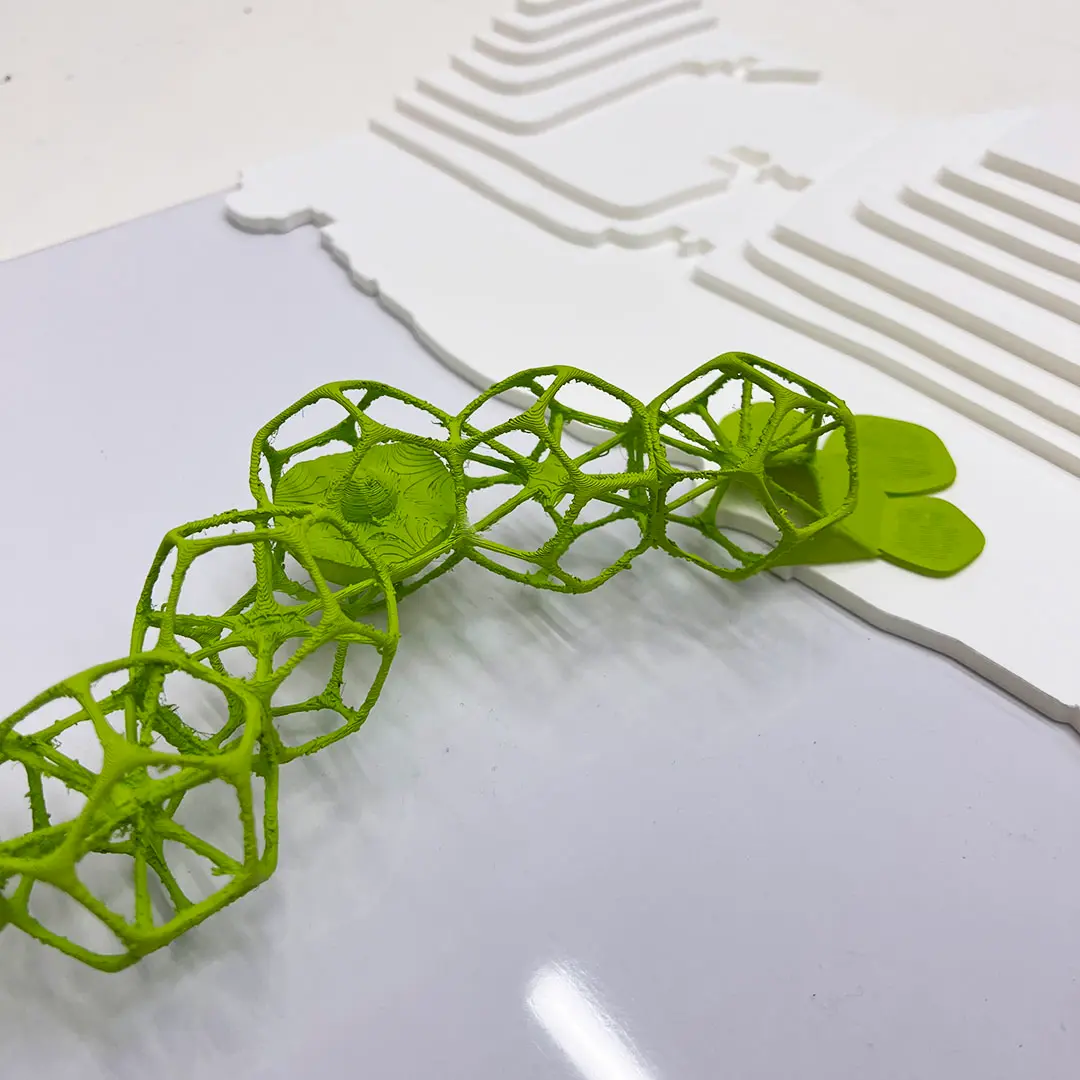
The image shows a detailed view of an architectural prototype created using 3D printing.  The model consists of a bright green lattice structure with hexagonal and geometric meshes, following a sinuous, organic path. This structure rests on a flat white base, next to another white architectural element characterized by stacked levels that resemble contour lines or tiered seating. The color contrast between the vibrant green of the complex structure and the white base highlights the experimental and innovative nature of the project, likely related to studies in biomimetics or parametric design.

The bridge is made up of thirteen dodecahedral modules connected by magnetic fields that allow the entire skeletal structure to float on the river. Three modules house the three main stages and activities of the food-related assembly line:

The Growing Module represents the first stage of the chain, housing a vertical garden necessary for the production of fruit and vegetables. The inhabitants of the bridge are educated and involved in the growing of the garden, becoming aware of the process and able to harvest fresh food;

The Distribution and Consumption Module is a real food arena of consumption and resource sharing, distributed through a market where food is prepared and distributed through portholes in the walls;

The Upcycling Module is dedicated to the activity of disposal and recycling of food waste, used within a self-sustainable bridge-building cycle and in new objects.

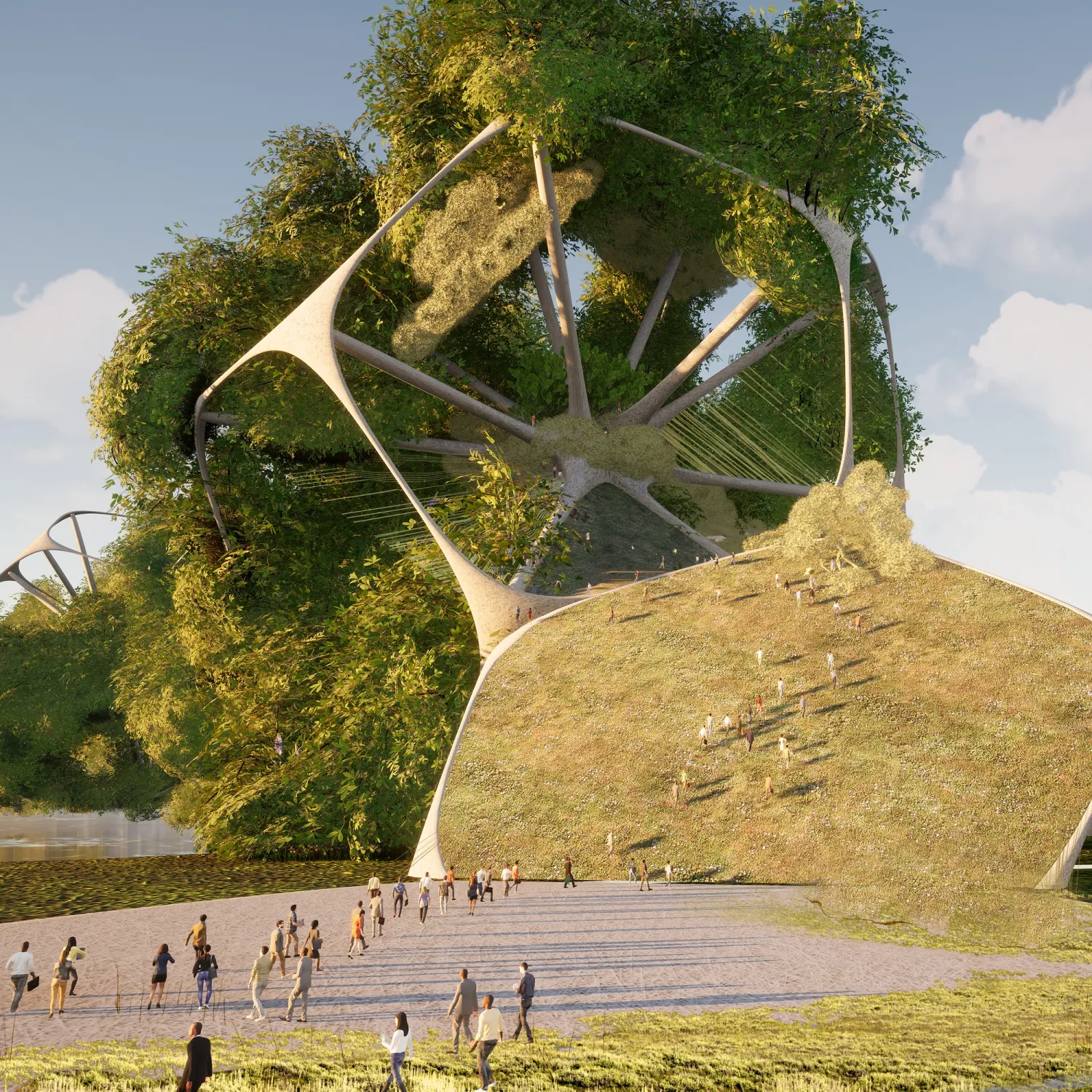
The image displays an architectural rendering of a futuristic, biophilic structure that integrates nature with public spaces. The scene features a monumental organic framework characterized by large circular and triangular forms supporting dense, suspended tree canopies. In the foreground, a wide, grass-covered sloping ramp allows people to ascend toward the upper levels, while at the base, numerous citizens walk through an open area that resembles a park or a sandy plaza near the water. The design suggests a harmonious blend of modern engineering and the natural environment, creating a vertical urban ecosystem where greenery is the primary focus.
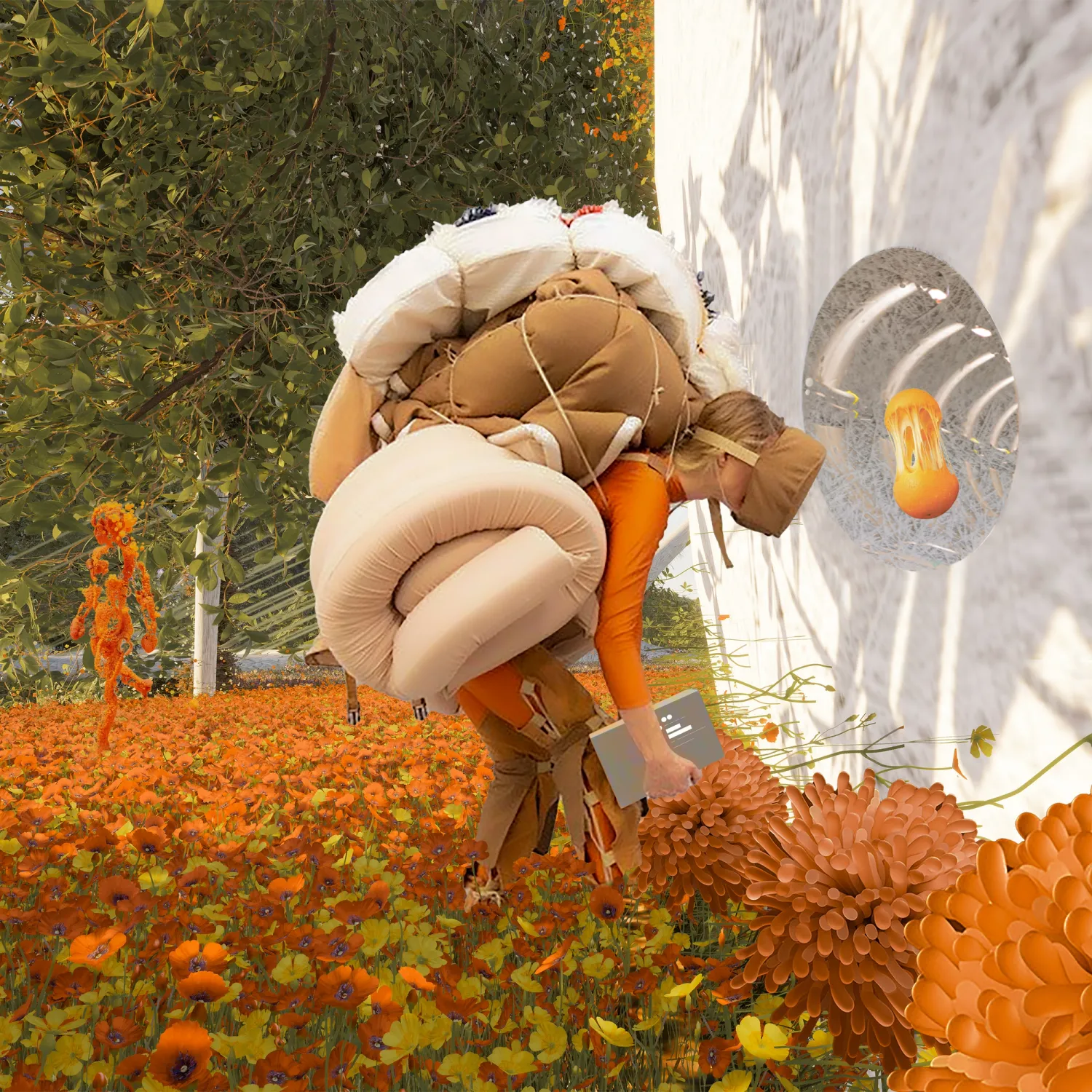
The image depicts a surreal scene where a human figure, burdened by a voluminous modular backpack made of quilted white and beige layers, is immersed in a field of orange poppies covering a table. The character wears an orange bodysuit and futuristic goggles while observing a white wall featuring a large circular mirror that reflects an indoor setting. The scenery blends nature and technology, showing networked architectural structures supporting suspended trees and bizarre orange creatures moving through the flowers in the background.

In Back to Nature, nature and bridge structure constantly intertwine until they merge. The core of the remaining ten modules consists of tubular structures that connect to the inner vertices of the module, which are made of biologically based porous material from food recycling, allowing the bridge itself to expand over time and allowing nature to colonise along the structure. Access to the bridge is emphasised by the presence of three pentagonal squares that serve as meeting places for people.

TEAM

Professors:
Ico Migliore
Paolo Giacomazzi
Rossella Forioli
Viola incerti

Students:
The Breathing Bridge
WenWen Liu
Veronica Piunti
Yue Wanqing
Yue Zhao

Back to Nature
Giuseppe Addati
Alice Bazzucco
Lorenzo Sardella
Ala Zhyvulka

Share on: