
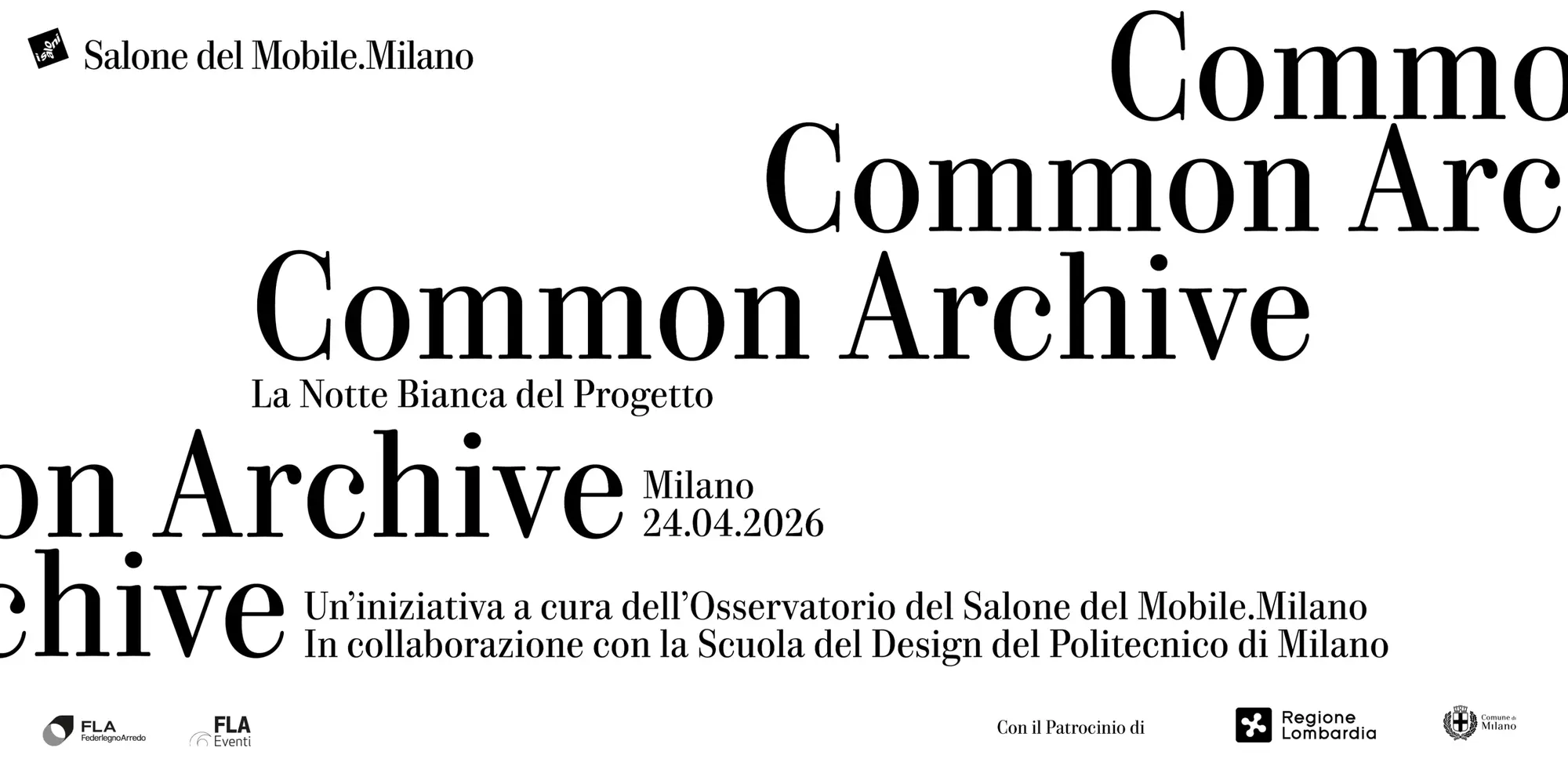
April 24, 2026, Milan
Common Archive – La Notte Bianca del Progetto is an initiative curated by the Salone del Mobile.Milano Observatory, in collaboration with the School of Design at Politecnico di Milano, and supported by the Lombardy Region and the Municipality of Milan. For the first time, the city’s historical archives of design and architecture open to the public through a unified, city-wide program, giving rise to an event that celebrates a unique cultural heritage deeply rooted in Milan’s identity.
The event originates within the research activities of the Observatory of the Salone del Mobile.Milano, and is part of the Annual Report (Eco)Sistema Design Milano 2025. The exploration and mapping of the key resources (actors and places) within Milan’s cultural design production, published in the 2025 Annual Report, was carried out in 2025 by a research group from the Department of Design composed of Francesco Zurlo, Stefano Maffei, Massimo Bianchini, Valentino Stella, Francesco Leoni, Filippo Parolini and David Zhou, with the valuable contribution of Graziella Leyla Ciagà, Gianpiero Bosoni and Francesco Guida
The initiative highlights the role of archives as active spaces of design: not merely repositories of memory, but places where design takes shape through materials, processes, and experimentation that precede the final work, revealing the complexity of design practice.
Through an open call, Common Archive brings together numerous Milan-based archives, institutions, and foundations – including the Cittadella degli Archivi, CASVA, Triennale Milano, Politecnico di Milano, and ADI Design Museum – alongside house-studios, archives, and foundations of major 20th-century masters such as Achille Castiglioni, Franco Albini, Vico Magistretti, Gae Aulenti, Gio Ponti, and many others.
The event unfolds as a city-wide evening program featuring guided tours, talks, and exhibitions, offering the public access to this ecosystem of knowledge. Common Archive transforms archives into a shared interpretative framework, highlighting both a living heritage and a research method that keeps design open to ongoing inquiry.
Politecnico di Milano participates with three initiatives:
Historical Archives of Politecnico di Milano
Building B1, Bovisa Durando Campus, Via Candiani 72
The Historical Archives of Politecnico di Milano preserve and provide access to materials from the University’s Historical Archive – documenting the institution’s history since its foundation in 1863 – alongside approximately 60 archives of architects, designers, graphic designers, and engineers.
During the event, visitors will explore the exhibition Archivi Passanti, featuring five archives – Steiner, Ghianda, De Carli, GPA Monti, and Crespi Grisotti – where it is possible to browse notebooks, sketches, and projects developed for Biennale, Triennale, fairs, and associations such as ADI.
Visiting times:
- 6:30 pm
- 7:15 pm
- 8:00 pm
- 8:45 pm
***
Politecnico di Milano – Design Philology
Building B4, Bovisa Durando Campus, Via Durando 10
Design Philology is a historical-philological research project that traces the evolution of design at Politecnico di Milano through an interactive digital archive. Based on documents and testimonies, it is structured into navigable narrative paths and has led to the exhibition Design Convivio, which brings design masters into dialogue, highlighting memory, research, and innovation.
During the visit, participants will be able to explore the digital archive with the support of the research team and experience the installation, which stages an imaginary conversation among eight Politecnico masters – Gio Ponti, Franco Albini, Carlo De Carli, Marco Zanuso, Achille Castiglioni, Vittoriano Viganò, Alberto Rosselli, and Raffaella Crespi – on the project’s key themes.
Visiting times:
- 6:00 pm
- 7:00 pm
- 8:00 pm
***
INTERDEPENDENCE: past, present, future
Fabbrica del Vapore, Via Giulio Cesare Procaccini 4
Politecnico di Milano and CASVA invite the public to a special evening opening of the exhibition INTERDEPENDENCE: past, present, future, an exploration of design as a tool to interpret the past, address the present, and imagine possible futures. The exhibition features projects by students from Politecnico di Milano and 50 international design schools, in dialogue with a selection of historical design pieces from the CASVA archive.
Free entry until 10:00 pm.
Access is by reservation only, subject to availability. Participation is free of charge.
Registration is required via Jotform.
For more information, visit the Salone del Mobile.Milano website.
Curated by: Susanna Legrenzi, Osservatorio Salone del Mobile.Milano; Massimo Bianchini, Stefano Maffei, Francesco Zurlo, Politecnico di Milano.