
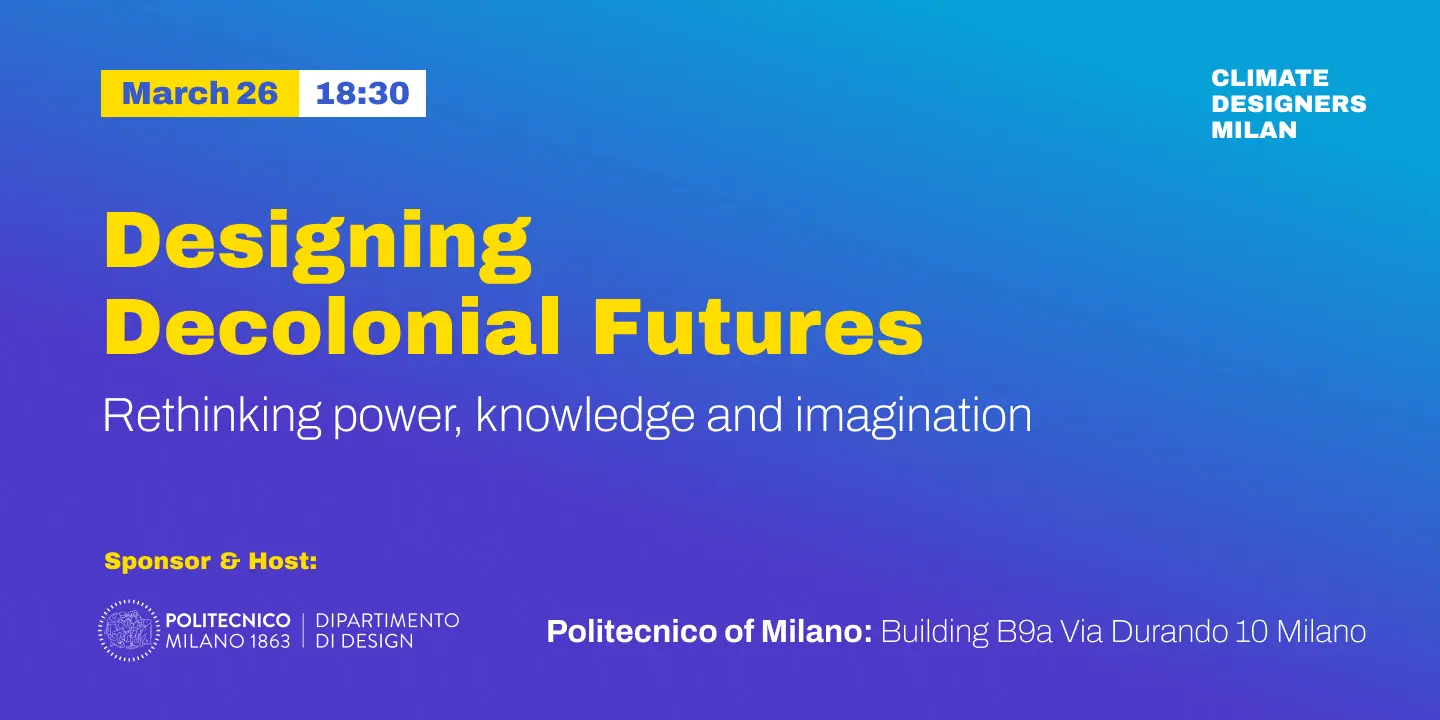
March 26, 2026, 6:30 pm, Design Social Club, building B9A, Bovisa Durando Campus, Milan
The Design Department will host the next gathering proposed by Climate Designers Milan, a growing local community committed to addressing climate change. The initiative supports professionals, researchers, students, and companies working in the field of design by fostering connections, encouraging collaboration, and creating opportunities for shared learning around the urgent challenges of the present.
How have colonial histories shaped the designs we create today?
The event will explore the ways in which colonial histories continue to shape contemporary design practices. As highlighted by educator and designer Danah Abdulla, design decisions are never neutral; they are embedded within political, cultural, and historical frameworks: 'With every design, there's potential not just to exclude, but to oppress. Every design vocabulary has its history and context'.
Design education has traditionally been structured around a limited canon, largely defined by European and North American perspectives. This has contributed to the marginalisation of non-Western cultures and alternative knowledge systems, presenting particular standards as universal. Recognising the situated nature of these standards is a key step in engaging with decolonial approaches.
The discussion will also address how shifts in mindset and practice may emerge through ongoing reflection and learning. As noted by anthropologist Dori Tunstall: 'decolonization is a journey. Stay curious, keep learning what we haven't lived'.
To attend, please register on the Humanitix website.
AGENDA
Welcome
_
Talks:
The Colonised Imagination: Unlearning the hidden foundations of design
by Carolina Cardoso, Futurist & Foresight Strategist
This talk explores the hypothesis that the categories through which notions of taste, rationality, modernity, and possibility are perceived are not innate, but historically constructed. It examines five centuries of cultural production in which specific systems of knowledge, aesthetics, and power have been naturalised. The continuity of this system is traced from colonial structures to contemporary economic, educational, and algorithmic infrastructures that continue to shape perception. The talk analyses how these assumptions have become embedded in aesthetic canons, design education, and technological systems, contributing to what is recognised as rational, modern, and desirable. Rather than proposing solutions, it calls for a critical awareness of the implicit frameworks that structure design, its purposes, and the futures it helps to produce.
Designing in Relation: Decolonising the way we design futures
by Alexanda Whitcombe, Regenerative Designer & Founder of Kootuia
This talk addresses decolonising design as a profound transformation of relationships between people, land, and systems of knowledge, rather than solely a change in outputs. It reflects on practices and approaches developed over the past decade within complex, multi-stakeholder contexts, highlighting the importance of relational and intergenerational perspectives. A critical examination of the biases carried by designers, storytellers, and creators is proposed, alongside an interrogation of the dominant narratives that design solutions often continue to reinforce. The role of designers, innovators, and decision-makers in shaping future visions is emphasised, particularly in relation to power dynamics and responsibility. The talk invites consideration of more inclusive, relational, and long-term approaches, especially in the context of climate futures.
_
Q&A
_
Netweaving
_
SPEAKERS
Carolina Cardoso: is a Foresight & Business Strategist, Futurist, and Specialist in Sustainability and Regenerative Economics. With over 20 years of experience in multinational companies such as Luxottica and Hewlett-Packard, I have led high-performance teams in 17 countries. She has solid experience managing brands like Ray-Ban, Chanel, Oakley, Sunglass Hut, and Lenscrafters with a special focus on retail and consumer behavior. She has launched pioneering educational initiatives at the intersection of design and wellness, influencing industry standards. Champion climate action within the design community, advocating for and leading discussions on the role of creatives in environmental stewardship. Carol's strategic thinking combined with a passion for multicultural environments, consumer insights, future thinking, innovation, and entrepreneurship behavior helped her acquire a unique grasp to generate value for brands and stakeholders.
Alexanda Whitcombe: is a regenerative designer, futures strategist, and former university lecturer. He is of indigenous Māori descent, with ancestral ties to the Pacific Islands of Niue and Rotuma and heritage to the United Kingdom. Alexanda is the founder of Kootuia, a social impact consultancy whose name reflects its mission—to interlink, connect, and forge relationships. Through Kootuia, he works to create lasting intergenerational impact across urban regeneration, circular systems like the food sector, and education - empowering the next generation to shape a more sustainable and connected world.