
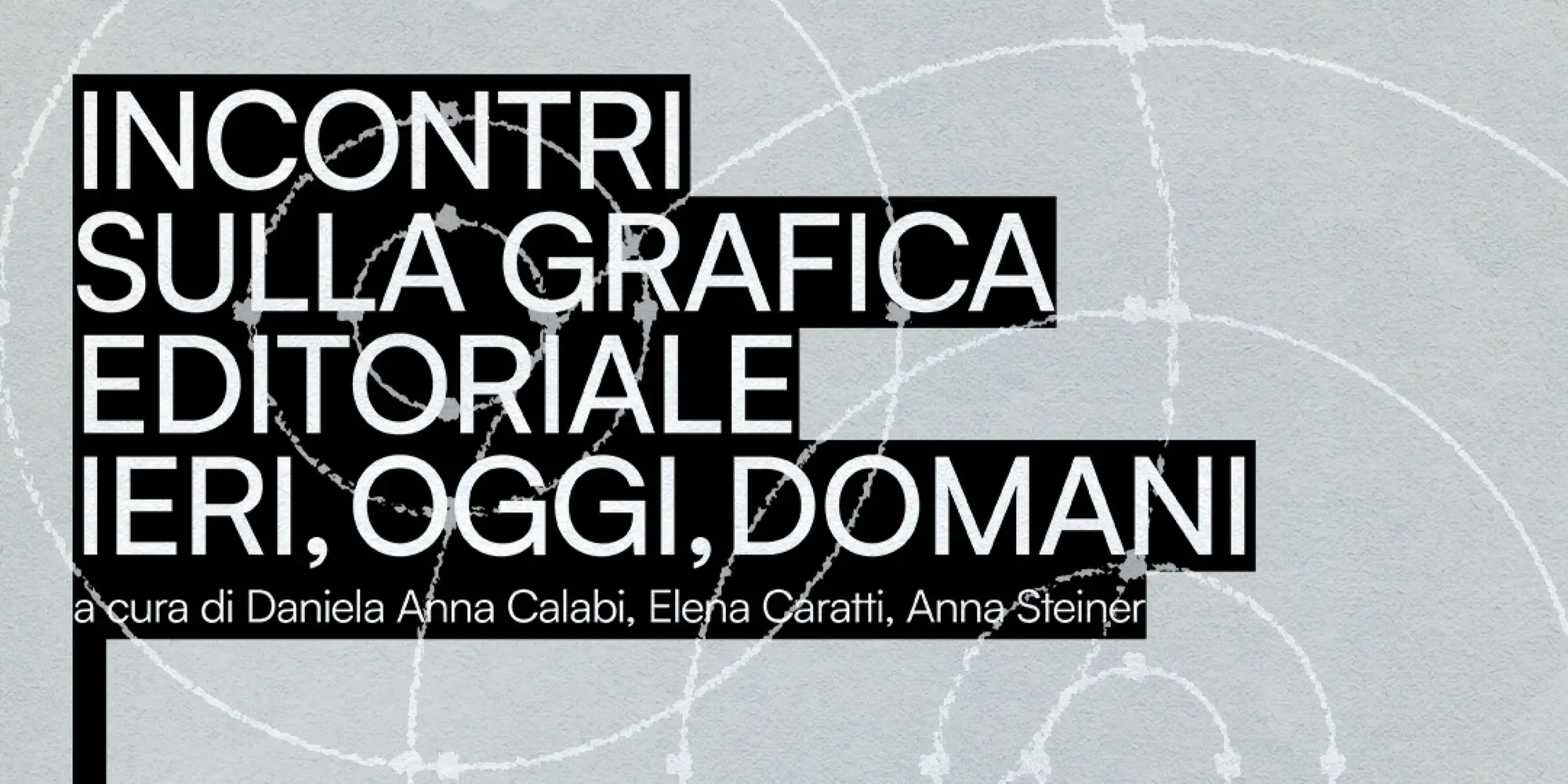
May 7, 2026, from 9:30 am to 12:00 pm, Room B2.1.9, Building B2, Bovisa Durando Campus, Milan
The Editorial Design Talks, now in their second edition, return within the Editorial Design Studios of the Bachelor’s Degree in Communication Design at the Politecnico di Milano as a space for dialogue between teaching, research, and design culture, curated by Daniela Anna Calabi, Elena Caratti and Anna Steiner.
This year’s title, “Ieri, oggi, domani. Design, cultura, etica”, clearly outlines the initiative’s scope: to reflect on editorial design as a field where disciplinary memory, present transformations, and responsibility toward the future are increasingly intertwined. The talks aim to explore the evolution of editorial design not only in its formal and linguistic aspects, but also in its cultural and ethical implications.
Editorial design has always played a crucial role in constructing and transmitting content, visions, and systems of values: it acts as a tool for access, orientation, and mediation, but also as a critical device capable of interpreting the present and shaping future imaginaries. Today, within a context marked by profound social, technological, and linguistic changes, it continues to redefine languages, media, and relationships with audiences, confirming itself as one of the most significant domains within design culture.
Alongside established formats, hybrid configurations are emerging, intertwining print and digital, image and data, word and space-opening up new possibilities as well as new questions. In this scenario, editorial design stands out not only for its formal quality, but for its ability to construct meaning, make content accessible, and give visibility to conscious and responsible cultural positions.
The talks are conceived as a public space for listening and discussion, primarily addressed to students but also open to anyone interested in understanding how publishing can still represent a privileged ground for design experimentation, critical responsibility, and the imagination of the future.
It is possible to attend the meeting online via the Cisco Webex platform.
Talk
9:40–10:20 am | Giovanni Baule
ETICHE EDITORIALI TRE MANIFESTI, DUE PROTOTIPI
Giovanni Baule is a key figure for understanding the meaning of these encounters. Through Linea Grafica, particularly between 1985 and 2007, he helped shape the magazine into a privileged observatory of the transformations in editorial graphics and communication design. His editorials accompanied a crucial transitional phase, focusing on the relationships between design culture, shifts in visual languages, innovation, and critical responsibility. In this sense, Linea Grafica can be reread as a true “laboratory of transition,” and Baule’s contribution as an authoritative guide to interpreting the challenges that still affect editorial design today.
10:30–11:10 am | Giovanni Cavalleri
LA-GRANDE TENTAZIONE: EDITORIA E INTELLIGENZA ARTIFICIALE
Giovanni Cavalleri brings to these meetings a highly contemporary perspective on editorial design, situated at the intersection of graphic culture, content production, and digital environments. Together with Cecilia Bianchini at the Paper Paper studio, he works along the shifting boundary between publishing, visual identity, and digital product design, within a practice that closely observes current transformations in editorial languages. In this context, his contribution on the emergence of artificial intelligence in publishing becomes an opportunity to question not only new tools, but also the evolving responsibilities of design, the changes in ideation and production processes, and the increasingly delicate relationship between automation, authorship, and visual culture.
11:20–12:00 am | Claude Marzotto Caotorta
LA TEORIA DELRECIPIENTE E ALTRI LIBRI
Claude Marzotto Caotorta brings to these encounters a profile in which graphic design, research, and editorial culture are deeply intertwined. Through the studio òbelo, which she co-founded with Maia Sambonet, she has long worked across the fields of art, education, and culture, engaging with content that requires not only visual clarity but also interpretative depth and meaning-making. In this framework, the experience of Archivio magazine, whose graphic design is developed by òbelo, clearly shows how editorial design can become a tool for organizing, transmitting, and enhancing memory-transforming complex cultural materials into readable, rigorous, and accessible formats. Her contribution to the seminars thus lies at the point where editorial design becomes care for content, a form of research, and cultural mediation.