
Design challenges in creative systems. Theories, methods and practices for sustainability and inclusion

Edited by Paola Cordera and Raffaella Trocchianesi

Design Challenges in Creative Systems. Theories, Methods and Practices for Sustainability and Inclusion, edited by Paola Cordera and Raffaella Trocchianesi, explores the dynamic systems of creativity and culture across various design fields, with a particular focus on the themes of sustainability and inclusion.

It brings together theoretical reflections, case studies, methodologies, tools and original practices that demonstrate how design can contribute significantly to local development, community regeneration and the co-creation of cultural, economic and social value. In an era of profound transformation, production cycle crises, and pandemic-accelerated new habits, the book emphasises the pivotal role of digital technologies in redefining the relationship between designers, stakeholders, and the public, and in expanding the possibilities of interaction between the physical and virtual worlds.
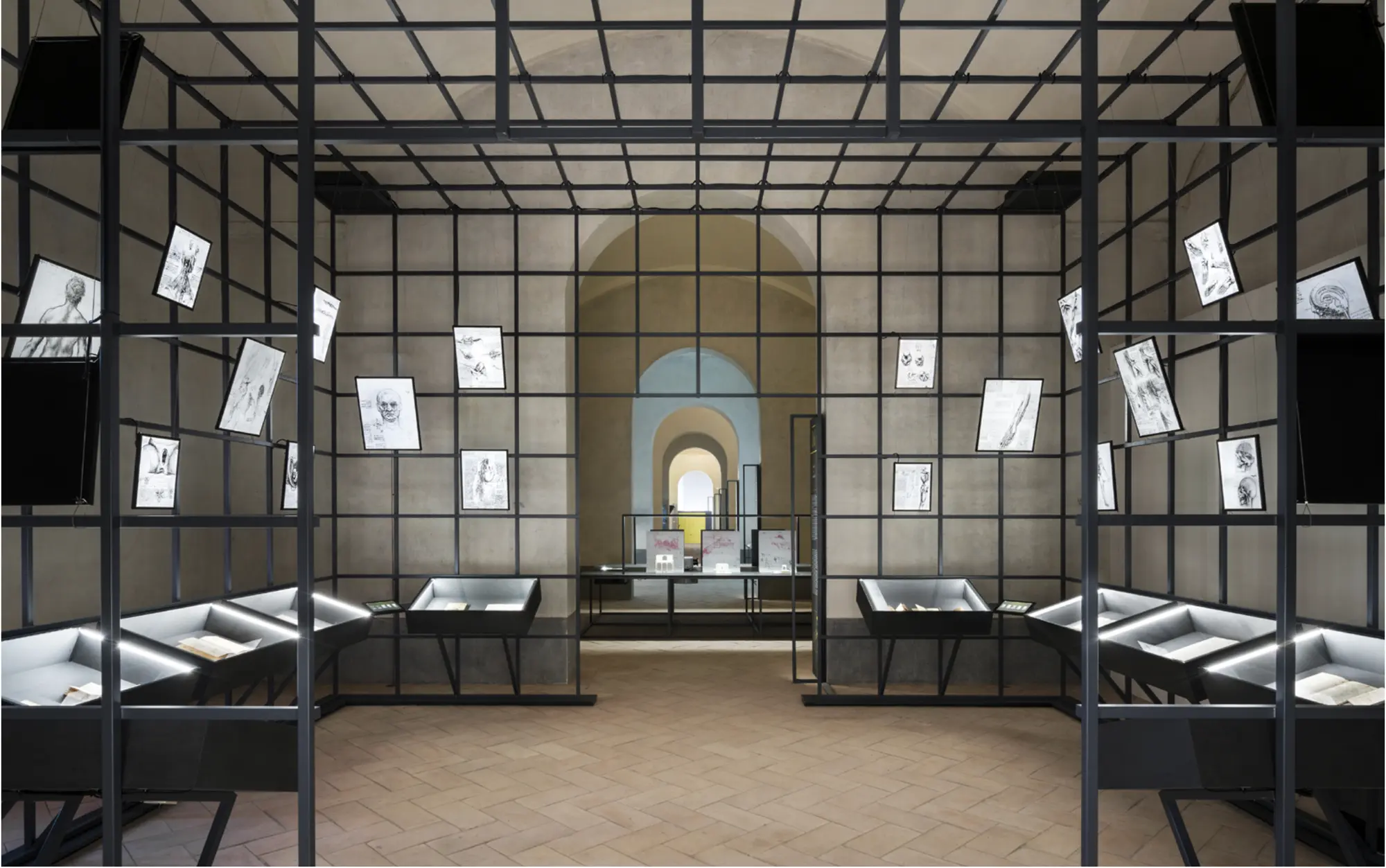
The last image shows a museum exhibition display with a rigorous and geometric design. Inside a historical hall featuring terracotta flooring and a perspective series of arches in the background, a full-height black metal grid structure has been installed, covering the walls and ceiling. Framed sketches and illustrations are hung on this grid, while tilted, backlit showcases at the base display open books or documents. The installation creates a modern dialogue between the classical architectural shell and a contemporary modular display system.
Leonardiana. Un museo nuovo, Castle of Vigevano (Pavia) 2016, Migliore+Servetto, photo by Andrea Martiradonna. Image taken from the essay 'The museum in the perspective of cultural proximity' by Ico Migliore.

Adopting a critical and multidisciplinary approach, the volume addresses the challenges of the Anthropocene — the current geological era characterised by the significant impact of human activities on planetary balances — by proposing approaches that enhance creative industries as engines of local development and active participation. The contributions collected here invite us to rethink accessibility, multiculturalism, and inclusion, as well as to reconsider the social and political positioning of the cultural system.

The volume aims to propose innovative models for cultural engagement and the development of more sustainable and inclusive communities through interdisciplinary collaboration and the adoption of design practices oriented towards systemic change.

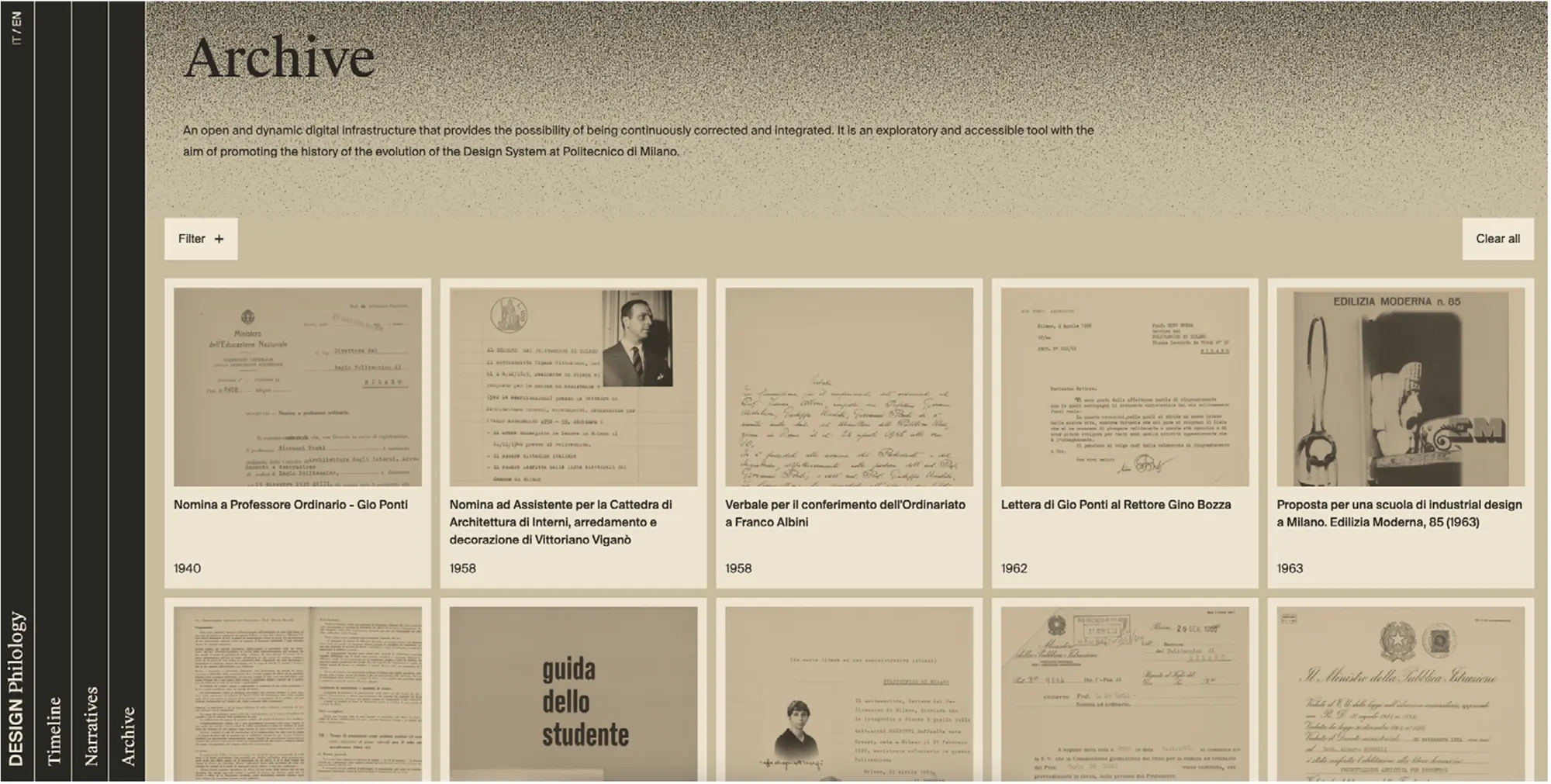
The last image shows the "Archive" section of the "Design Philology" digital project, described as an open infrastructure to promote the history of the design system at Politecnico di Milano. The screen features a grid of digitized historical documents, including official letters, academic appointments, and publications ranging from 1940 to 1963. The materials include references to illustrious figures such as Gio Ponti, Franco Albini, and Vittoriano Viganò, organized chronologically with explanatory captions on a grainy sand-colored background.
Design Philology's digital archive. Image taken from the essay 'Design cultures and digital humanities. The case of Design Philology' by Agnese Rebaglio and Laura Carugati

The book is available on the FrancoAngeli Open Access platform.

Contributions: Giuseppe Amoruso, Suzie Attiwill, Ilaria Bollati, James Bradburne, Laura Carugati, Luisa Collina, Peter Di Sabatino, Elena Elgani, Giulia Gerosa, Federica Guarnieri, Rossella Locatelli, Eleonora Lupo, Ico Migliore, Polina Mironenko, Agnese Rebaglio, Dina Riccò, Michele Trimarchi, Qing Yu.

Design Challenges in Creative Systems, available in the FrancoAngeli open access catalog, is one of the three volumes published within the Dipartimenti di Eccellenza – Design for Systemic Change project. Through this brief series of three collective volumes, the Department of Design showcases its transversal and synergistic research and presents a selection of European research projects aligned with the project’s objectives.

Share on: