ReverseLab arrives at PAC

Pilot project for contemporary art between the prison and the city

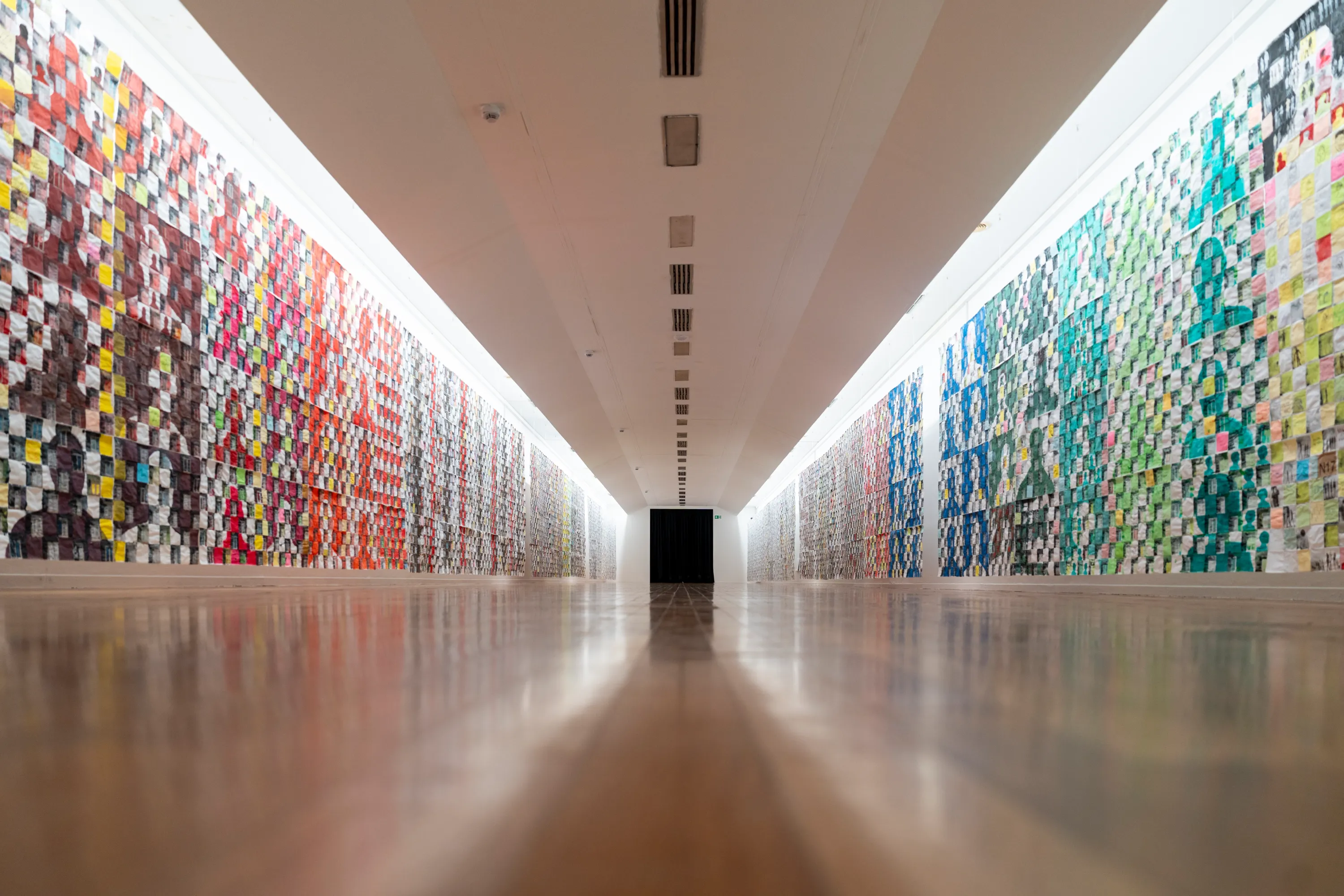
A long perspective corridor with walls entirely covered by thousands of small colored notes and images, creating a massive visual mosaic. The polished floor reflects the ceiling lights, leading the eye toward the dark end

From October 14 to 26, 2025, PAC - Padiglione d'Arte Contemporanea hosted ReverseLab. Pilot project for contemporary art between the prison and the city, was created through a collaboration between San Vittore Prison, Politecnico di Milano and PAC, with the support of Fondazione di Comunità Milano, Forme Tentative and Philo – Pratiche filosofiche.

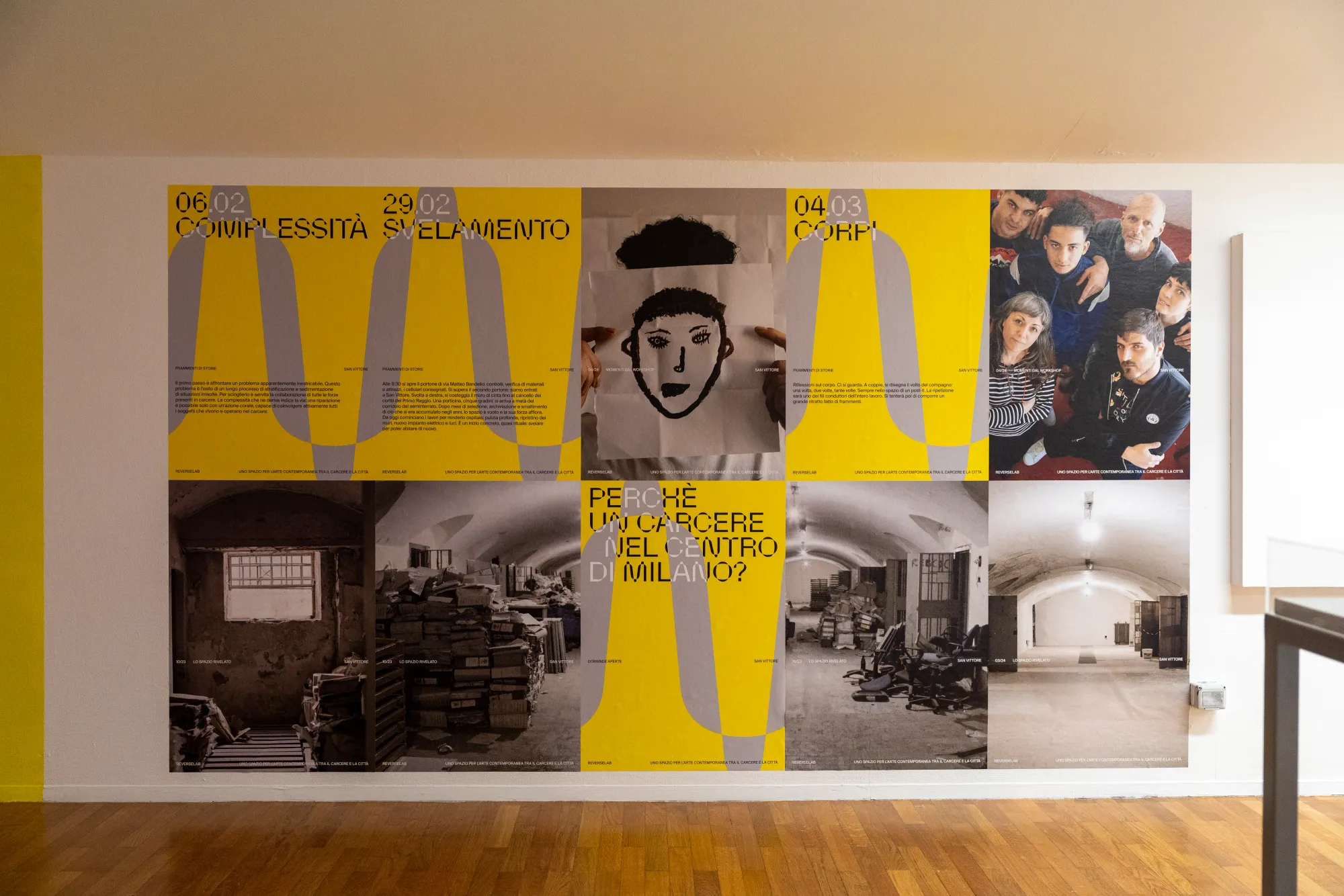
The wall installation features a grid of posters combining yellow and blue graphic elements with black-and-white and color photographs. In the center, a provocative question stands out: "WHY A PRISON IN THE CENTER OF MILAN?", suggesting that the exhibition focuses on the San Vittore prison and its relationship with the city. The posters include portraits, stylized illustrations, and shots of bare interiors and warehouses, likely documenting a research project or workshop (as indicated by the dates at the top: 06.02, 29.02, 04.03)

The Project

The ReverseLab project, promoted by the 'Laboratorio Carcere' research group at the Politecnico di Milano's Departments of Architecture and Urban Studies and Design, has created an artistic production and exhibition space open to the public by reusing the basement of the first wing of San Vittore prison. ReverseLab is a social design laboratory that not only designs environments, but also activates relationships, cultural production and reflection on living, symbolism and the complex relationship between the prison institution and the urban context. From March to November 2024, 40 inmates participated in a collective process of reflection and creation alongside artist Maurice Pefura. The result is a transformed space and a narrative that opens up to the city, presenting the public with the questions that arose within the prison walls.
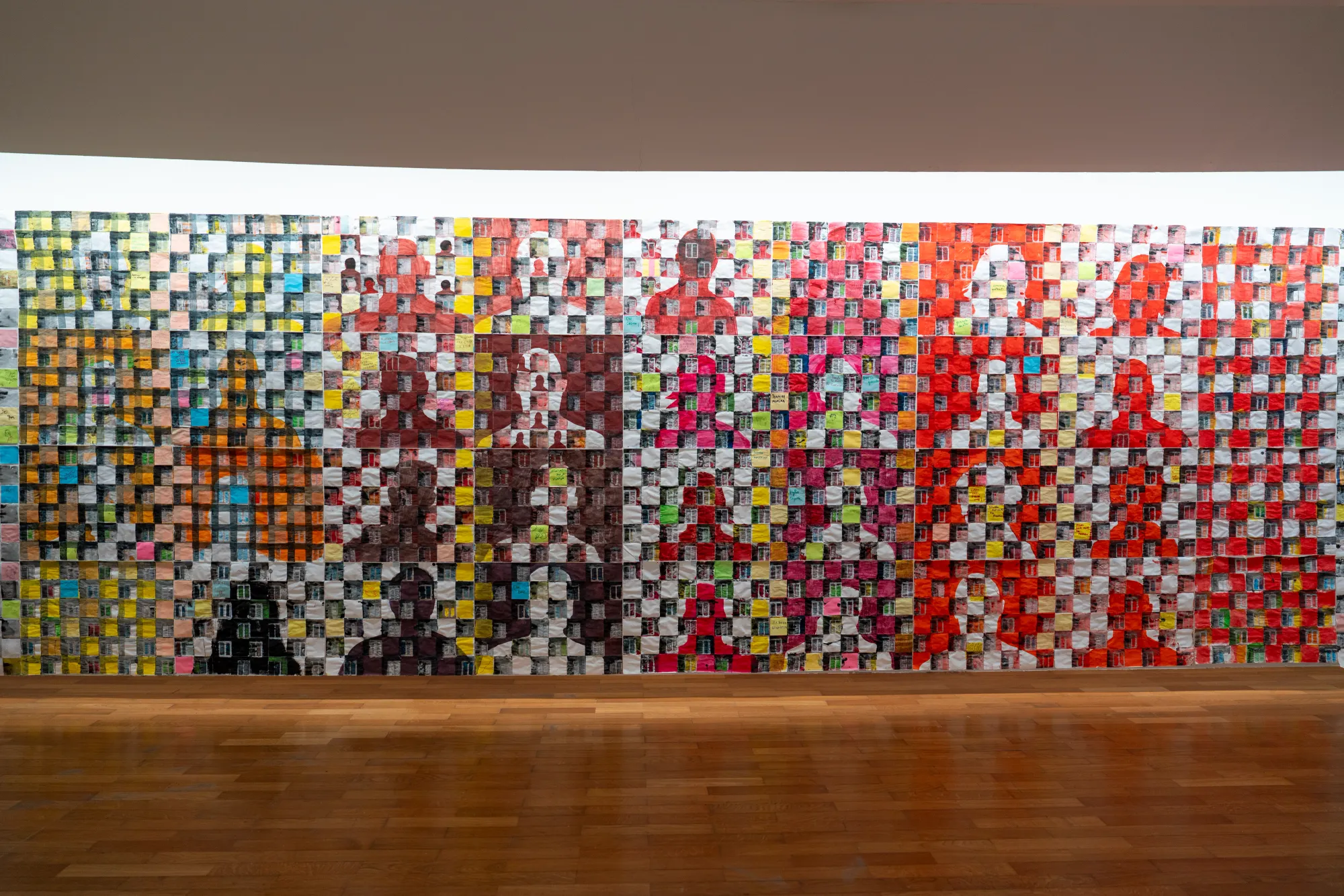
An impressive installation in an art gallery where thousands of small sheets and images form large-scale human silhouettes along a perspective corridor

The aim of ReverseLab's proposal for San Vittore was to strengthen exchanges and projects between the prison and the outside world. This intention has been fully realised with the arrival of the workshop at PAC, a space that is open and accessible to all.

«ReverseLab is a pilot project that aims to provide a space for those who don't have one; to connect prisons and cities through art. It is an artistic journey that enables us to transcend the boundaries of our bodies and walls, and to shine a light on our shadows as individuals and as a society. As researchers and students active in Off Campus San Vittore, we carry out this work by intertwining the experiences, knowledge and perspectives of prisoners, police officers, educators, healthcare personnel, prison management, other institutions and the third sector, with the aim of changing the narrative around prisons and thinking of them as part of a multifaceted city where relationships can give rise to new possibilities. »

Francesca Piredda, Associate Professor and member of the interdepartmental group Laboratorio Carcere (Design and DAStU)

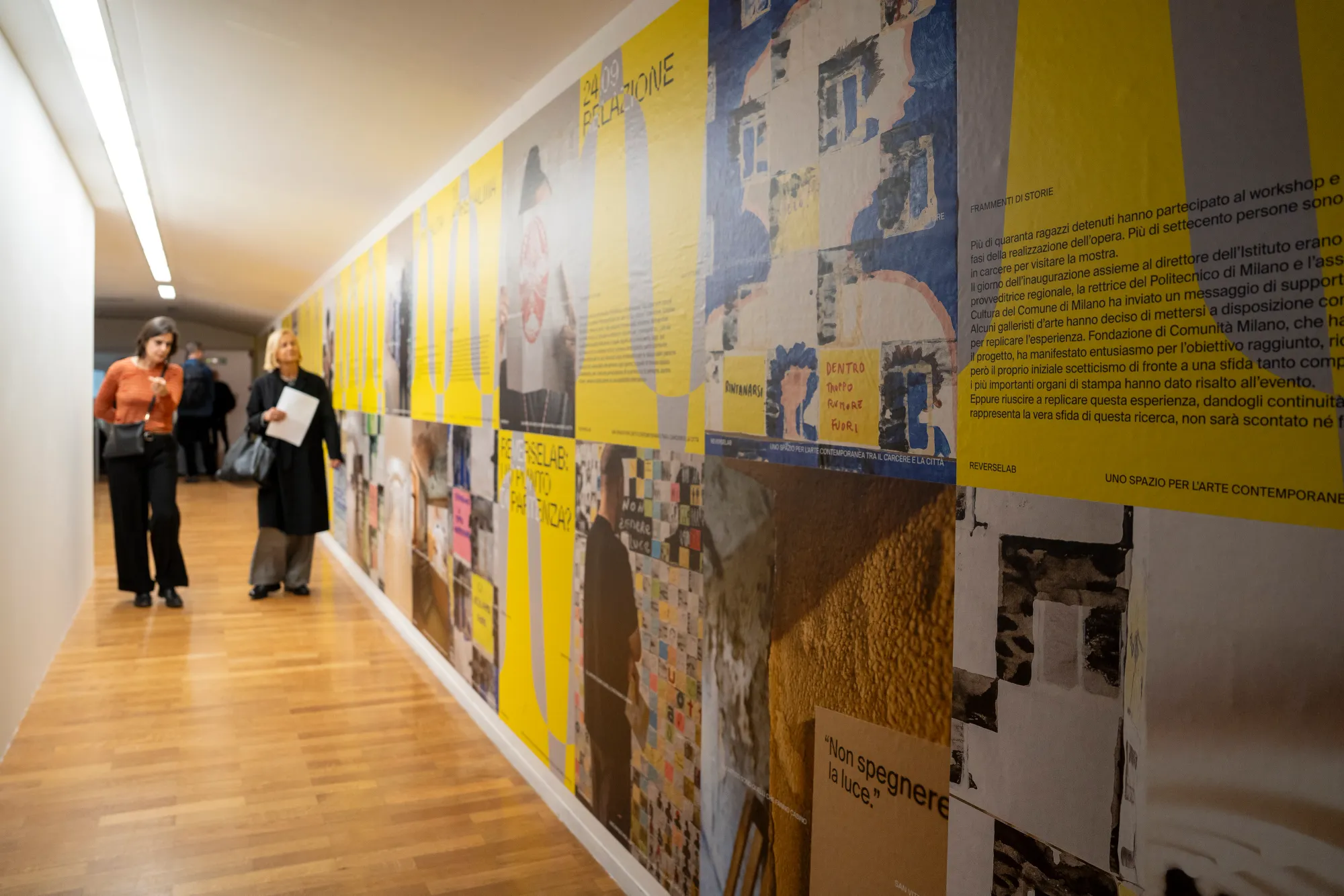
The photograph shows a long corridor with parquet flooring, illuminated by a continuous row of ceiling lights. On the right wall, a series of posters and information panels are installed, combining yellow graphics, photographs, and dense text. In the foreground, a panel features the quote "Non spegnere la luce" (Don't turn out the light), while further down, people can be seen walking through the space and observing the exhibition. The project appears to be linked to social or artistic research, similar to the previous images regarding urban and prison contexts

A fragment of San Vittore prison in the centre of Milan

An unexpected part of San Vittore prison took shape in the PAC Gallery and Project Room: a space suspended between time and memory, recounting the project's complexity.

The Project Room showcases the restoration and transformation work curated by Forme Tentative, as well as the workshop process led by Pefura. Meanwhile, the Gallery presents a scaled-down version of the artwork created within the prison, titled 'Gli Artisti Sono Quelli Che Fanno Casino' (Artists Are the Ones Who Make Noise). This is complemented by audio recordings in which inmates share insights into their daily lives and their relationship with the outside world, filling the space with the voices and sounds of the prison.

«The exhibition at PAC offered the prison and the city a new opportunity to meet and continue raising questions about our fragility. It gave space to the desire to avoid irrelevance in the face of the complexity of the present and to 'not turn off the light'.»

Francesca Piredda, Associate Professor and member of the interdepartmental group Laboratorio Carcere (Design and DAStU)

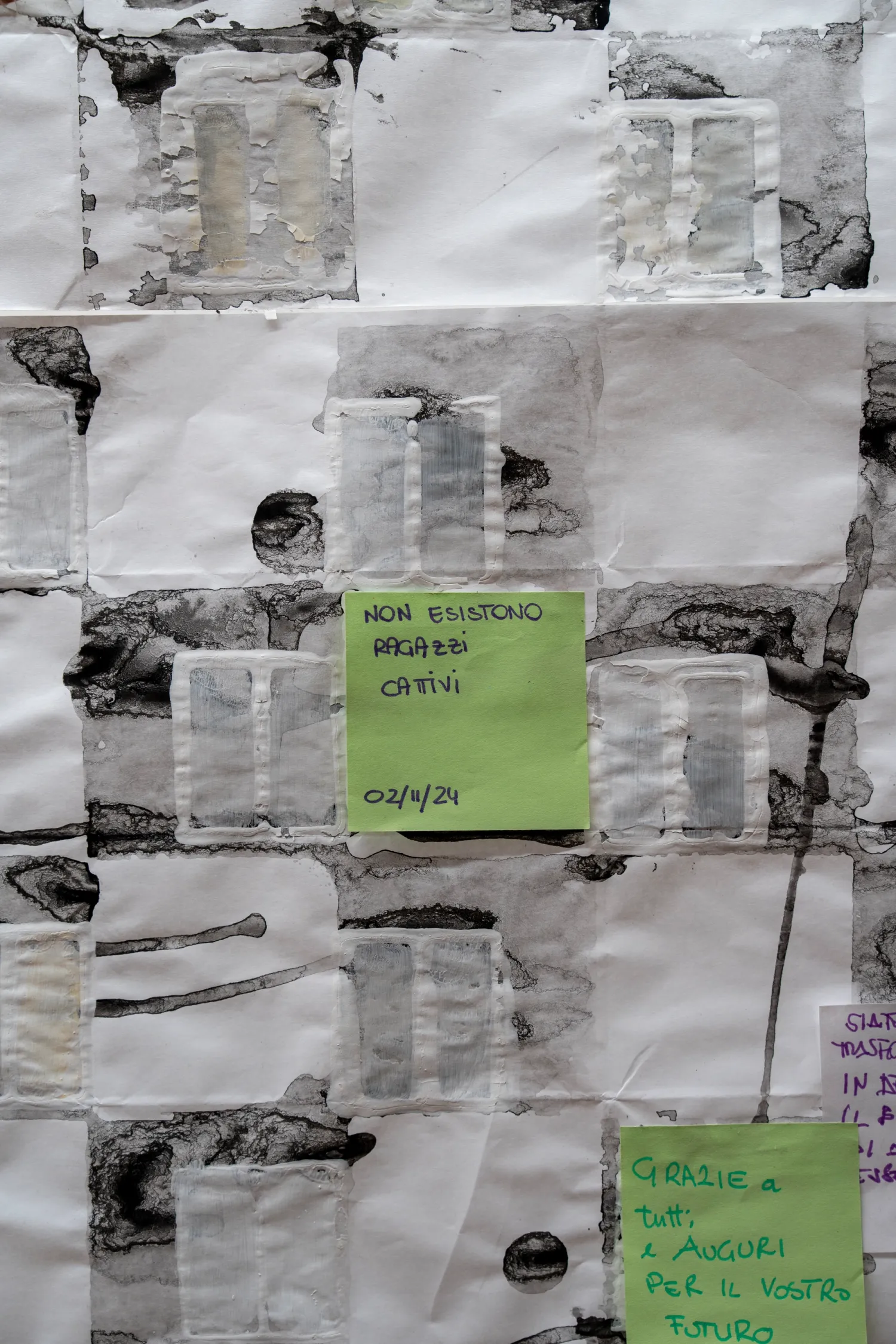
The image is a close-up of a section of the mosaic wall seen earlier. The background consists of white sheets with abstract black-and-white prints resembling window structures or building facades. Apple-green sticky notes with handwritten messages are attached to them. The central note carries the phrase: "NON ESISTONO RAGAZZI CATTIVI" (There are no bad kids), dated 11/02/24. In the bottom right, another note expresses gratitude and well-wishes for the future. It is a detail that imbues the entire work with significant human and educational value
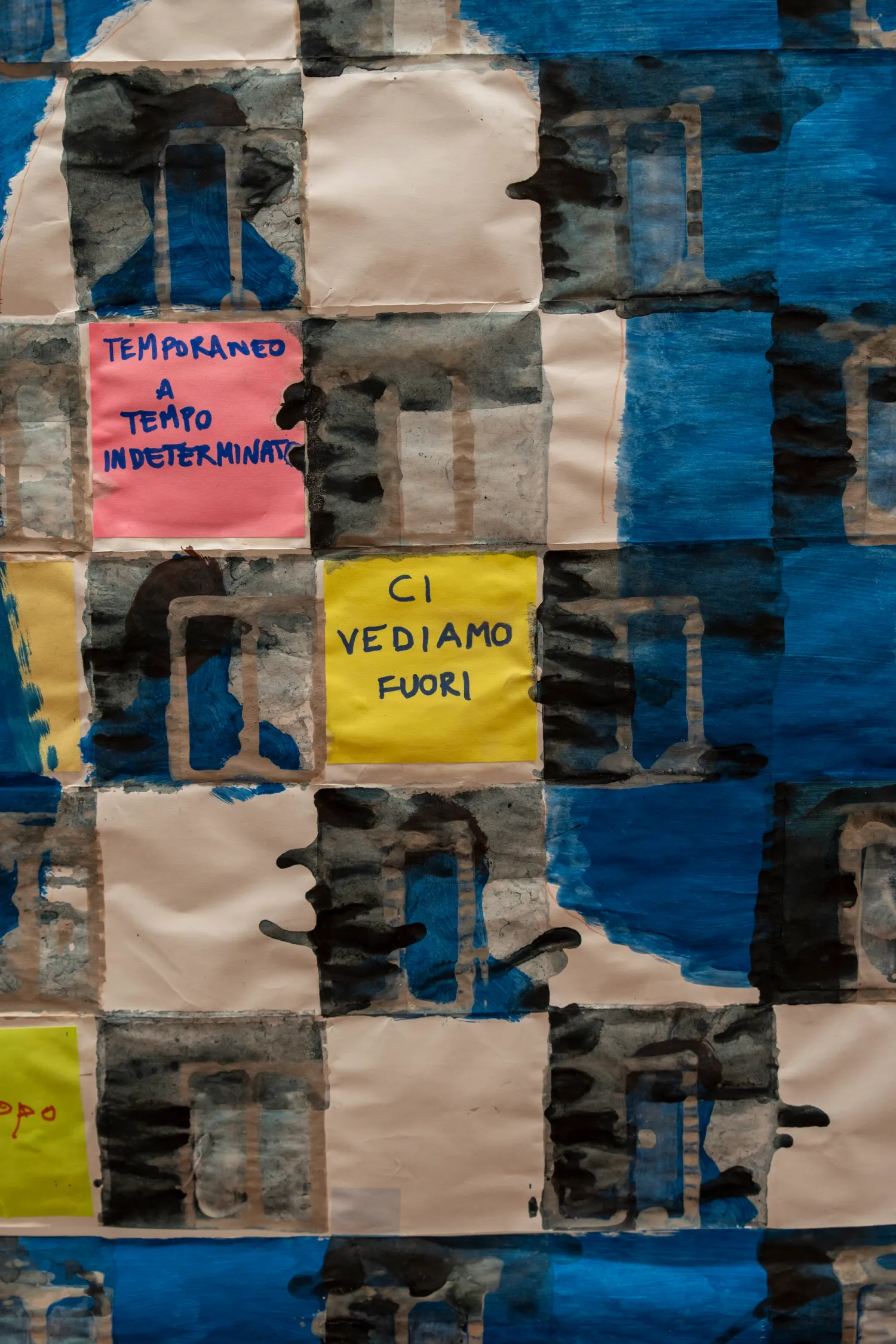
A close-up detail of a grid-based artistic collage. The work combines abstract black-and-white prints, reminiscent of architectural structures, with bold textured blue brushstrokes. Applied over this background are sticky notes with handwritten messages, most notably the yellow one: "CI VEDIAMO FUORI" (See you outside), a hopeful message of freedom and reunion that reinforces the social theme of the entire project

This transition — from the prison to the city — takes on strong symbolic value: the work 'leaves' San Vittore and raises questions that affect the city. These questions concern the meaning of prison, its position 'inside the body of the city and outside of time', the usefulness of art in places of detention and the potential of design research in prison contexts. The prison space is not erased at this juncture; it remains a place of memory and waiting, silent and laden with over 120 years of history. At the same time, however, it is transformed into a social resource: a place open to dialogue, reconnected to the city. It is the network of relationships built up over time that moves: a web of voices, experiences and questions that continues to grow and open up new possibilities for reflection and transformation.

For the Department of Design, this experience is a notable research model that transcends academia by engaging with complex urban and institutional contexts. It demonstrates how design can transform marginal spaces into platforms for connection and transformation.

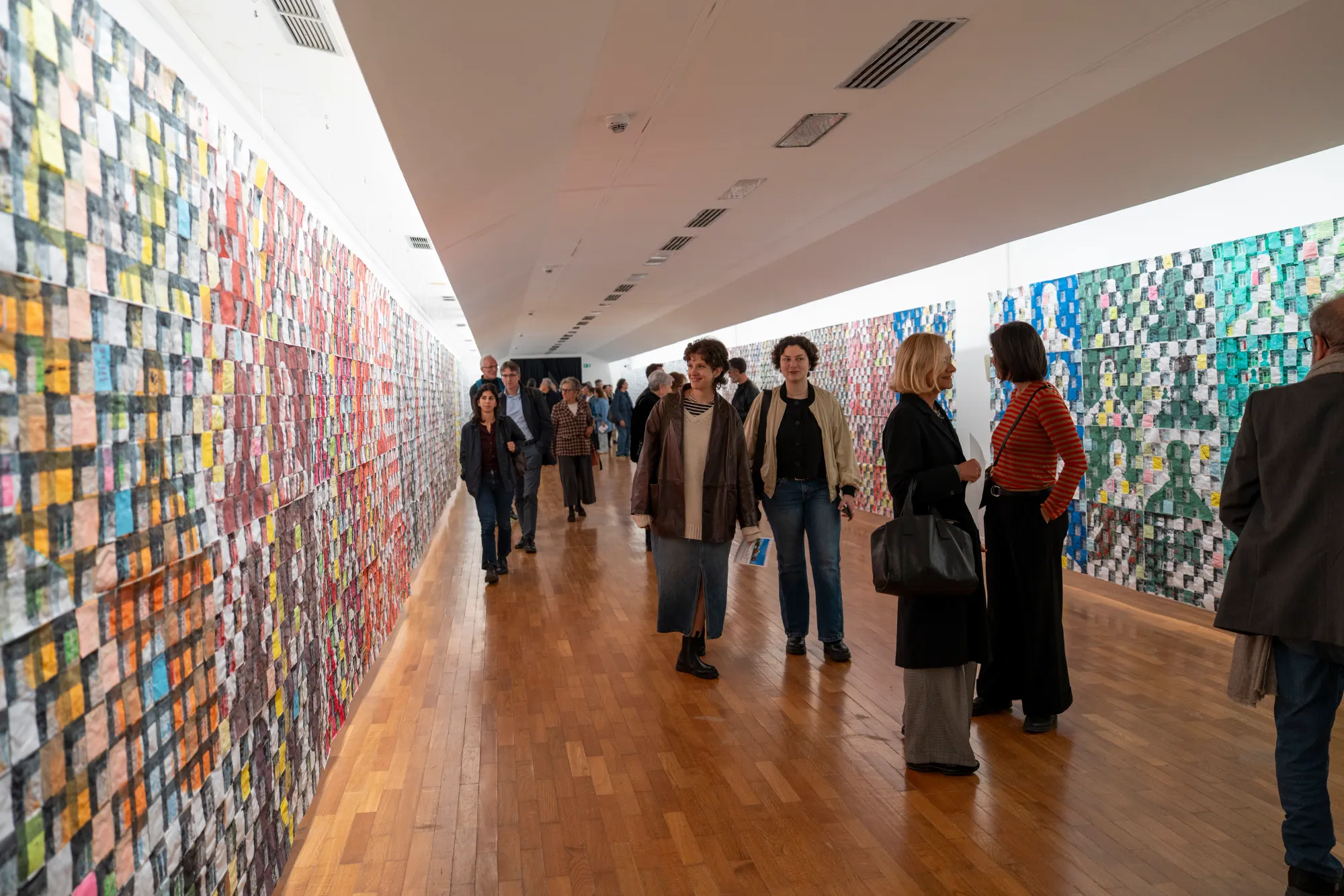
A view of the gallery's long corridor during the exhibition. Numerous visitors walk through the space, observing the massive installation made of thousands of sticky notes and images that entirely cover the walls, creating an atmosphere of sharing and collective reflection
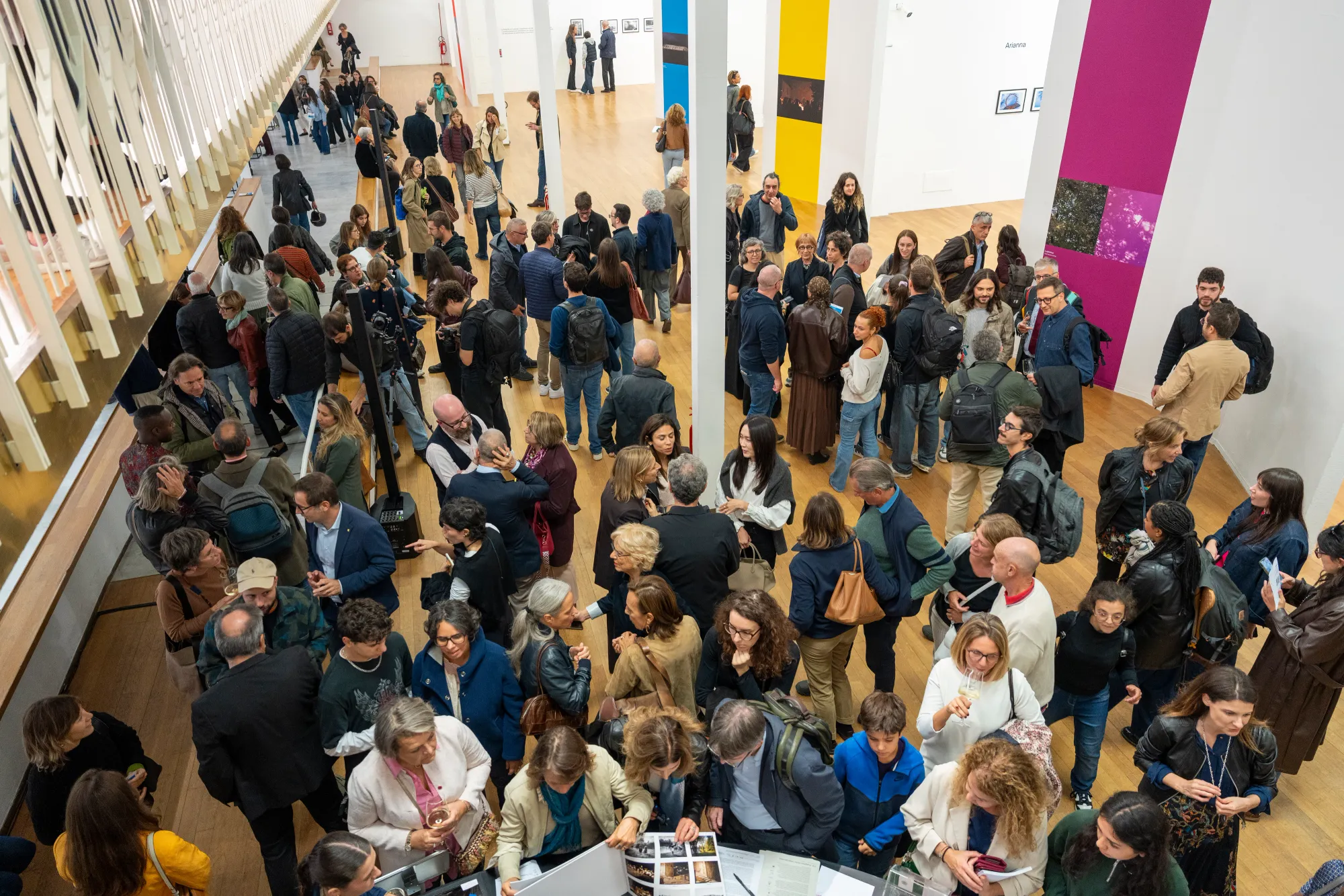
A high-angle view of a crowded art gallery during an opening or public event. The space is large, with wooden floors and tall white columns decorated with bright colored stripes (yellow, blue, fuchsia) that display photographic works. Numerous visitors move freely, creating a dynamic atmosphere of meeting and cultural exchange

Photo credits: Luca Tantimonaco.

Share on: