
Embracing Change and Supporting Transitions. Approaches to Systemic Change in Products, Services, and Systems

Edited by Stefana Broadbent and Silvia D. Ferraris

The last image is an abstract graphic background featuring a deep dark blue gradient. The composition maintains the visual consistency of the series, showcasing minimalist and blurred overlapping geometric shapes, notably radial elements resembling stylized stars or crosses and a partial circular form on the right side. The design is clean, modern, and professional, ideal for conveying a sense of technology, order, and institutional depth.

A new volume dedicated to the theme of transitions and systemic changes has been released: Embracing Change and Supporting Transitions.Approaches to Systemic Change in Products, Services, and Systems.

Bringing together studies and reflections on how design can address major social, environmental and technological transformations that are redefining our present and future, the book is edited by Stefana Broadbent and Silvia D. Ferraris.

This volume is one of three publications produced as part of the Dipartimenti di Eccellenza – Design for Systemic Change project, which was promoted by the Department of Design at the Politecnico di Milano. This editorial project involves the publication of collective volumes narrating the transversal and synergistic research conducted within the department, as well as essays focusing on a selection of European research projects sharing the innovation, sustainability and inclusion objectives of the Dipartimenti di Eccellenza project.

Embracing Change and Supporting Transitions. Approaches to Systemic Change in Products, Services and Systems is a book that explores how design is progressively integrating new disciplines, ranging from neuroscience and artificial intelligence to data analysis and feminist theory, in order to develop tools and methodologies that can address the growing complexity of contemporary society.

A key takeaway from the contributions is the shared vision that the changes we are experiencing require a collective, multidisciplinary approach. No single project can face the breadth of the current challenges alone, but each project can become part of an innovation ecosystem that grows through the contributions of many different actors.
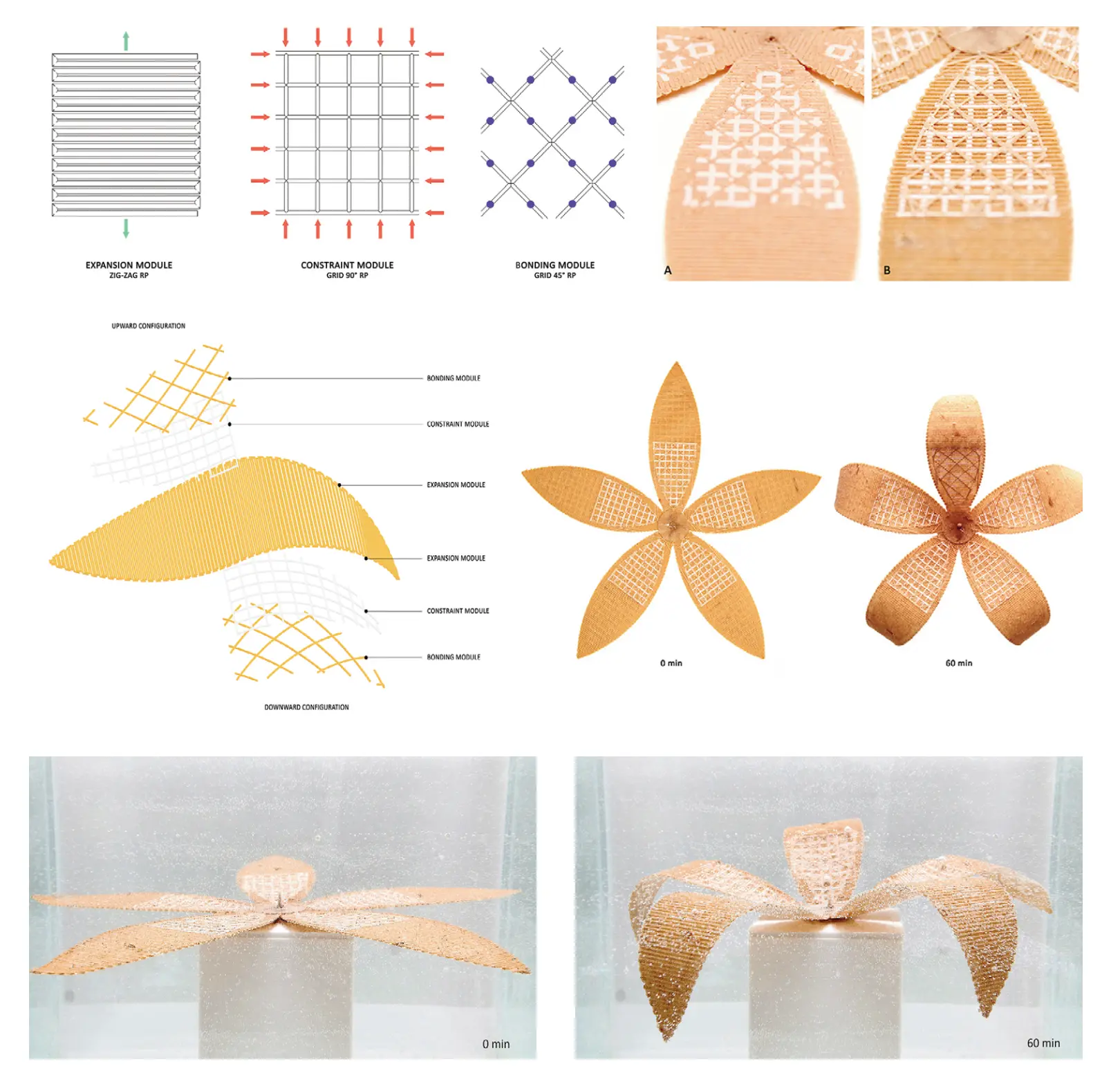
The last image illustrates the study and experimentation of a shape-memory or environment-reactive material, structured into various technical modules such as expansion, constraint, and bonding modules. It shows the behavior of a five-petaled flower prototype that, when immersed in a liquid or subjected to a stimulus for 60 minutes, changes its physical configuration from a flat shape to a three-dimensional one with curled petals. The document combines technical diagrams of construction grids, macroscopic details of surface textures, and a time sequence documenting its morphological metamorphosis.
The fabrication of biologically inspired and hygro-responsive morphologies with Wood Polymer Composites (WPCs), highlights how control of kinematics through computational design enables dynamic mechanisms of shape change in response to environmental factors. Source: M. Filippucci, G. Pelliccia, 2023. Image taken from the essay: ìDrawing, design and algorithms. Theoretical statements and experimental practice for a shared poiesis in the age of Artificial Intelligence' by Giorgio Buratti.

The volume is structured into three sections:

  • Embracing other disciplines: integrating new knowledge and cross-disciplinary approaches into design research, such as neuroscience, artificial intelligence, feminist theories, and the construction of new meanings.
  • New approaches for design research: explore new research practices, such as data management for urban biodiversity, the intersection between drawing and algorithms, game design as a motivational tool, and reflections on contemporary challenges in product development.
  • Design Practice for Supporting Transformation: Addressing complexity through meta-design, inclusive design, design thinking for entrepreneurial innovation, and the role of design in social innovation processes.
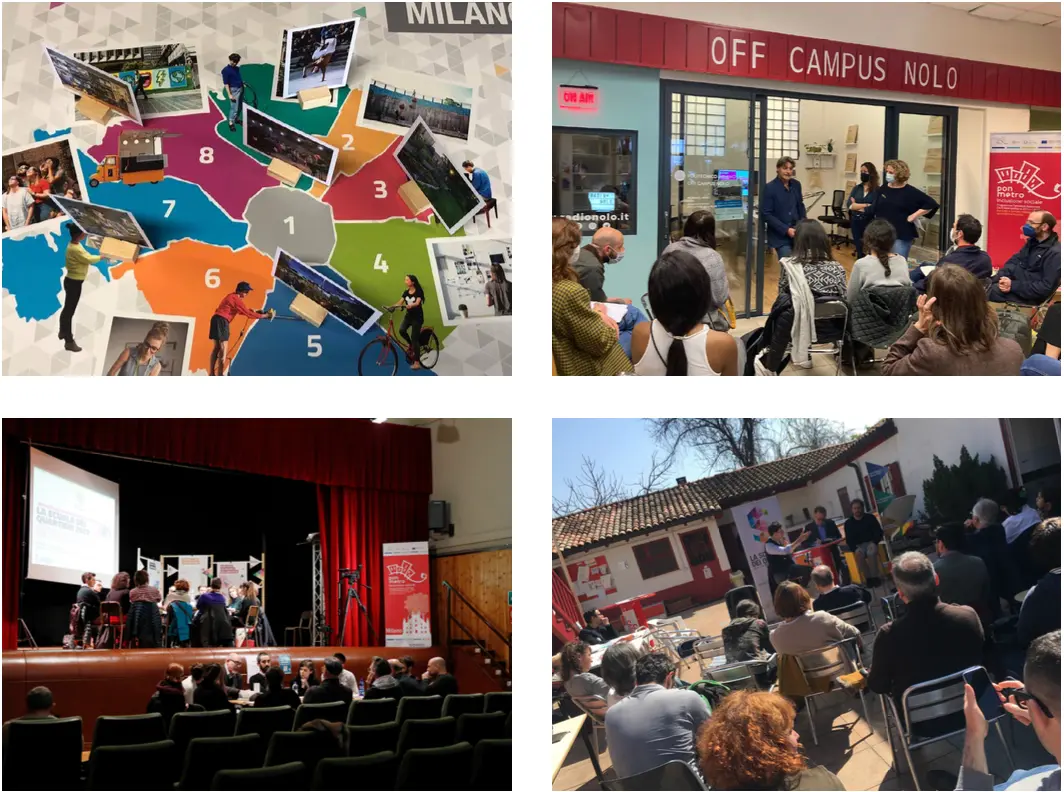
The image features a collage of four photographs documenting public participation and urban regeneration activities in Milan. The top-left corner shows a colorful map of the city divided into zones, enriched with photographs and cut-out human figures simulating a dynamic interaction with the territory. The other three photos depict moments of meeting and debate: a presentation at the "Off Campus NoLo" space, a round table on a theater stage with projections, and an outdoor meeting in a courtyard. Altogether, the set suggests a co-design process involving universities, institutions, and citizens in both academic and neighborhood contexts.
Peer-to-peer events, neighbourhood meetings and public presentations. Image taken from the essay 'Social innovation: from incubating to envisioning. Recovering the strategic dimension of design in supporting social innovation' by Marta Corubolo.

The volume offers an in-depth and up-to-date overview of design as a discipline capable of supporting and accompanying transformation processes with an open and responsible outlook toward the future and it's available in the FrancoAngeli open access catalog.

Contributions: Marco Ajovalasit, Giuseppe Andreoni, Venanzio Arquilla, Andrea Benedetti, Maresa Bertolo, Giorgio Buratti, Gianluca Carella, Federica Caruso, Luca Casartelli, Gabriele Colombo, Marta Corubolo, Joseph Giacomin, Svafa Grönfeldt, Margherita Pillan, Isabella Ruina, Carla Sedini, Srini R. Srinivasan, Francesco Zurlo.

Share on: