Liked, trapped, shared. Incontri digitali con la biodiversità

Exhibition opening

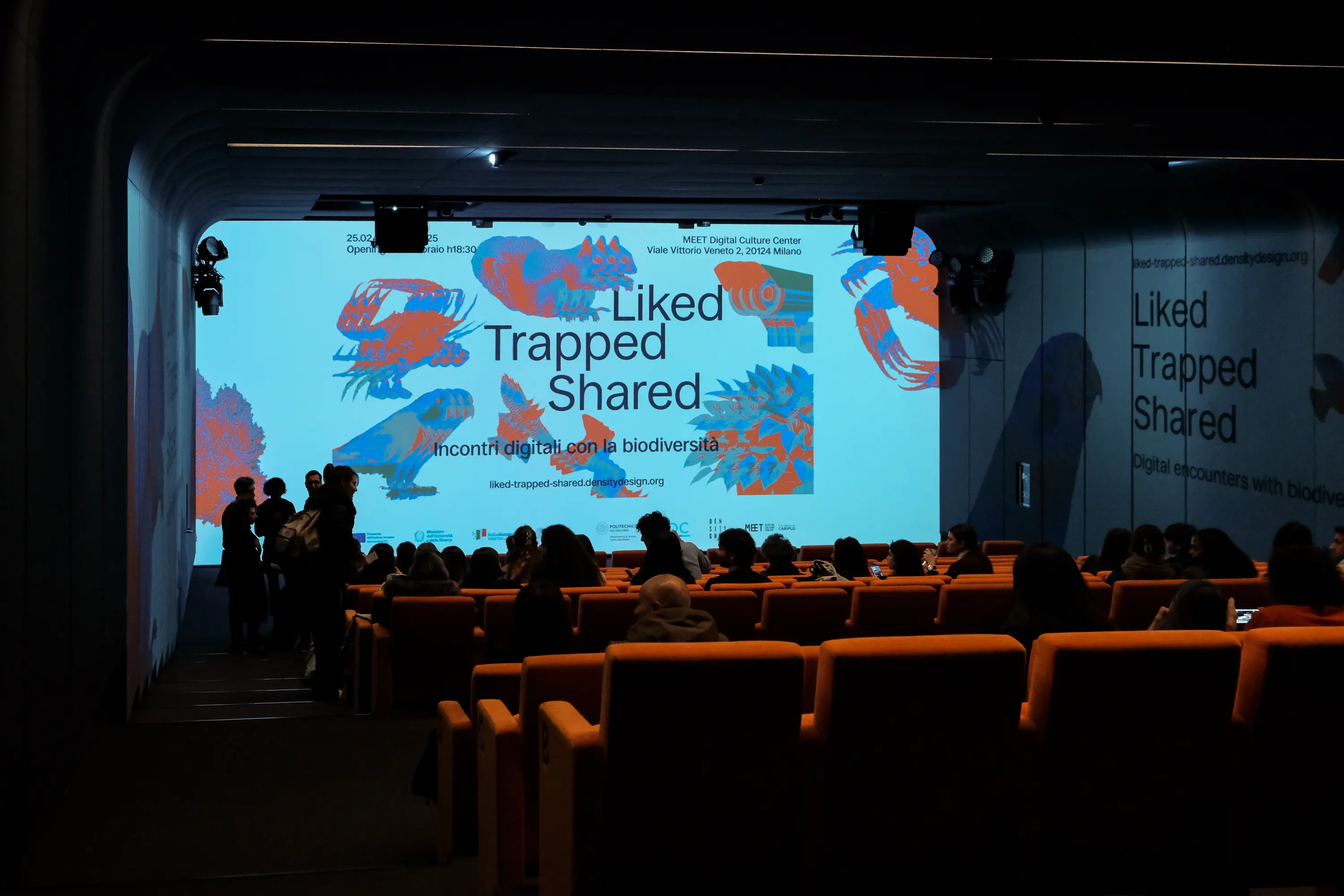
The image captures a moment of waiting or the beginning of a conference: several people are already seated in the audience, while on the left, a small group of participants is entering or chatting standing up. The architectural structure of the room, with its dark curved walls, perfectly frames the blue screen, creating a strong visual contrast that emphasizes the theme of the encounter between digital technology and the natural world.

The opening of the exhibition Liked, Trapped, Shared. Incontri digitali con la biodiversità, promoted by the National Biodiversity Future Centre, was held on Tuesday, February 25, 2025, at MEET Digital Culture Centre. The exhibition is part of a research project carried out at Politecnico di Milano involving over 50 students from the Master of Communication Design, coordinated by the DensityDesign Lab.

The exhibition, curated by Massimo Labra and Andrea Galimberti of Università degli Studi di Milano-Bicocca and Maria Chiara Pastore of Politecnico di Milano, explores the role of the digital in promoting new forms of coexistence with the non-human world, exploring the theme of biodivesity.

The opening event was attended by Alessandro Deserti and Paola Bertola, Director and Deputy Director at the Department of Design, and Donatella Sciuto, Rector at Politecnico di Milano.

Digital technologies are increasingly mediating relationships between humans and non-humans, creating new contact zones where different species interact. Online, animals and plants are photographed, quantified, hashtagged, passionately commented and discussed, shared and even offered for sale. These digital spaces foster complex dynamics: in some cases they reinforce power imbalances and accelerate extractive practices towards the non-human world, while in others they open up unexpected spaces of care and attention. Behind every conversation about a plant or an animal, there are often profound reflections on our relationship with nature.
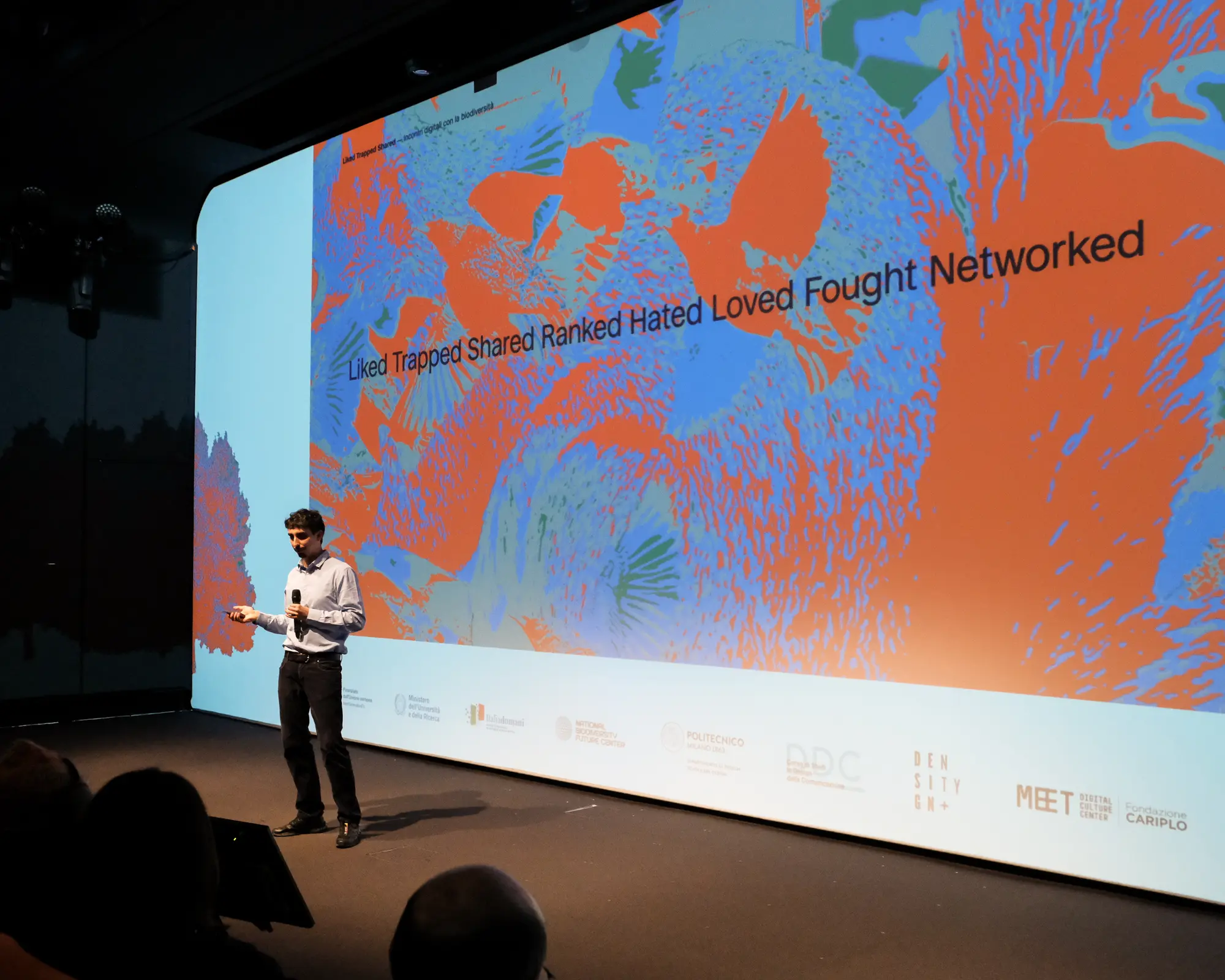
The image features a speaker on stage during a conference, gesturing with a microphone in front of a massive widescreen display. The projection showcases vibrant abstract graphics with the text "Liked Trapped Shared Ranked Hated Loved Fought Networked" and various institutional logos (including Politecnico di Milano and MEET) at the bottom. The shot from the audience, with silhouettes of attendees in the foreground, emphasizes the professional and engaging atmosphere of the event.
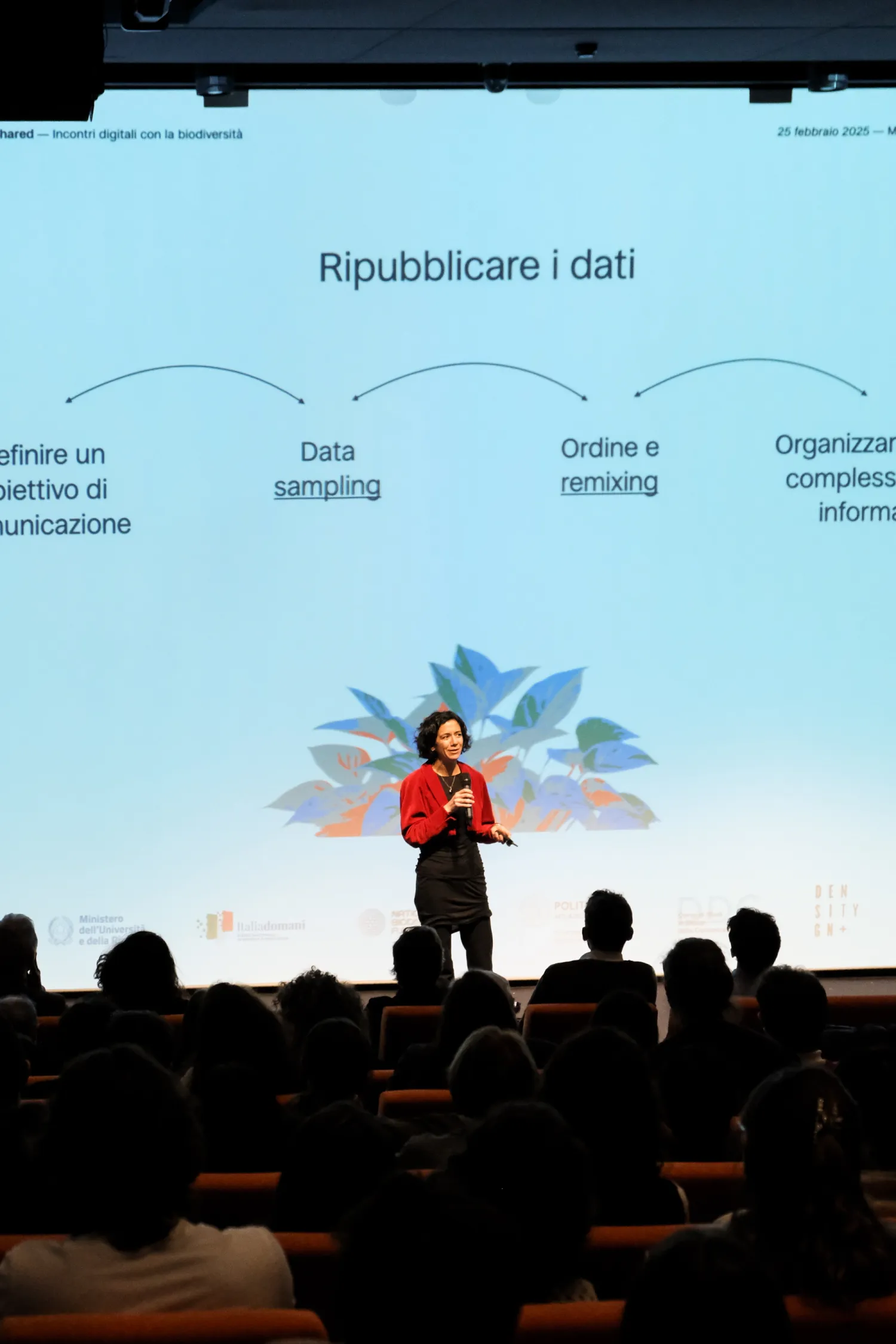
The image shows a speaker on stage during a public presentation titled "Ripubblicare i dati" (Republishing data). The woman, wearing a red jacket and a black dress, speaks into a microphone in front of a large screen illustrating a four-stage methodological process: defining an objective, data sampling, ordering and remixing, and organizing complexity. The slide features a central botanical illustration and institutional logos at the bottom, while the foreground shows the auditorium audience seated in shadow.
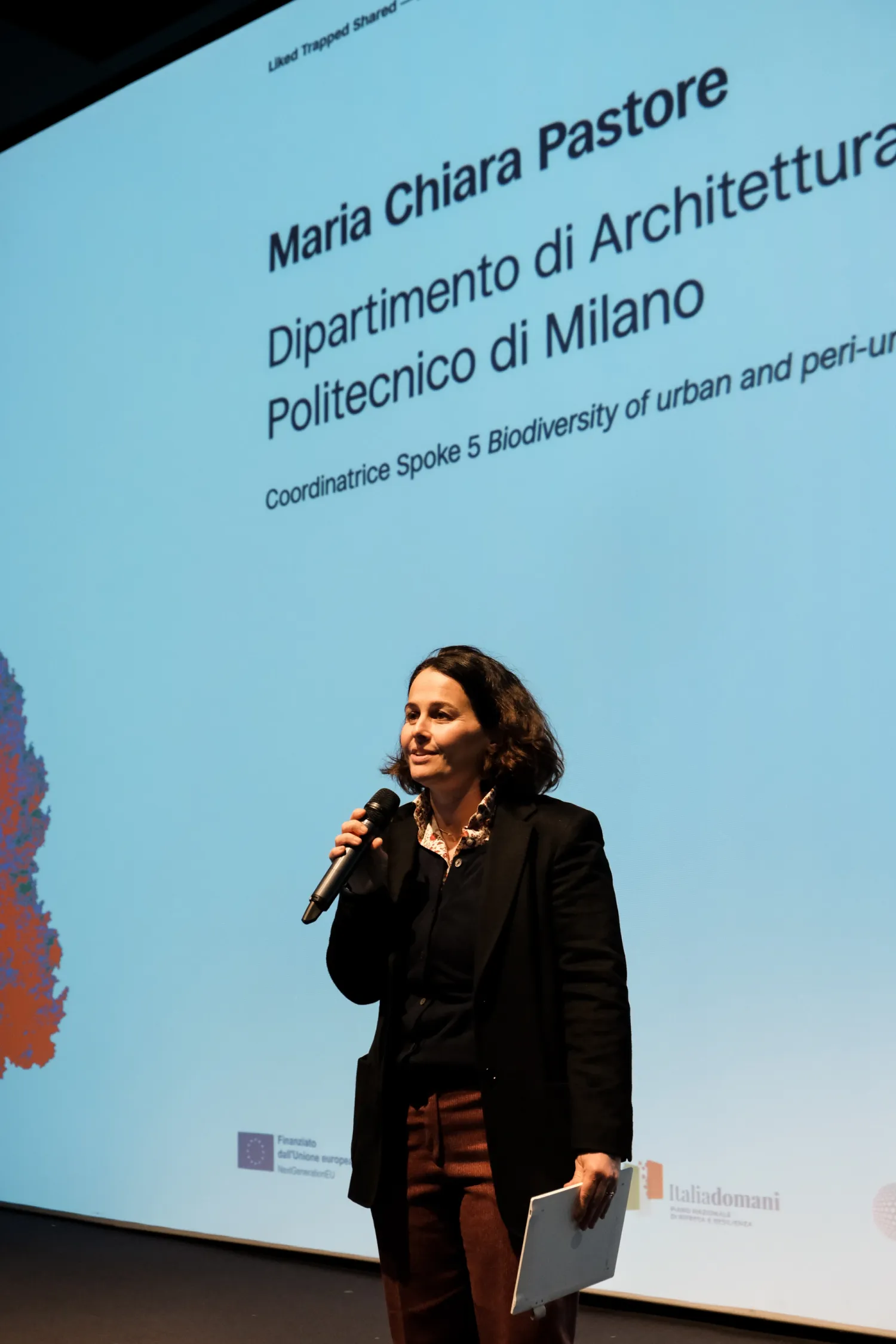
The image features speaker Maria Chiara Pastore, from the Department of Architecture at Politecnico di Milano, during a stage presentation. Behind her, a large blue screen displays her credentials and her role as coordinator for "Spoke 5 Biodiversity." Holding a microphone, the speaker is captured during a professional address before an audience (not visible), within a high-level academic and scientific dissemination context.

The exhibition

Liked, trapped, shared. Digital Encounters with Biodiversity presents eight works that, by recomposing textual and visual fragments from the web, offer an original look at the material conditions and symbolic elements that characterise digital interactions between humans and non-humans.

Handling Parakeet
Handling Parakeet is an interactive installation on the connection between humans and monk and collared parakeets in Italian cities. Through 885 online sales ads, it becomes clear how digital commerce has contributed to their spread, told through images of hands interacting with the birds. The hand becomes symbolic of this relationship, revealing how these animals are perceived and treated.

The Inventory of Bird Objects
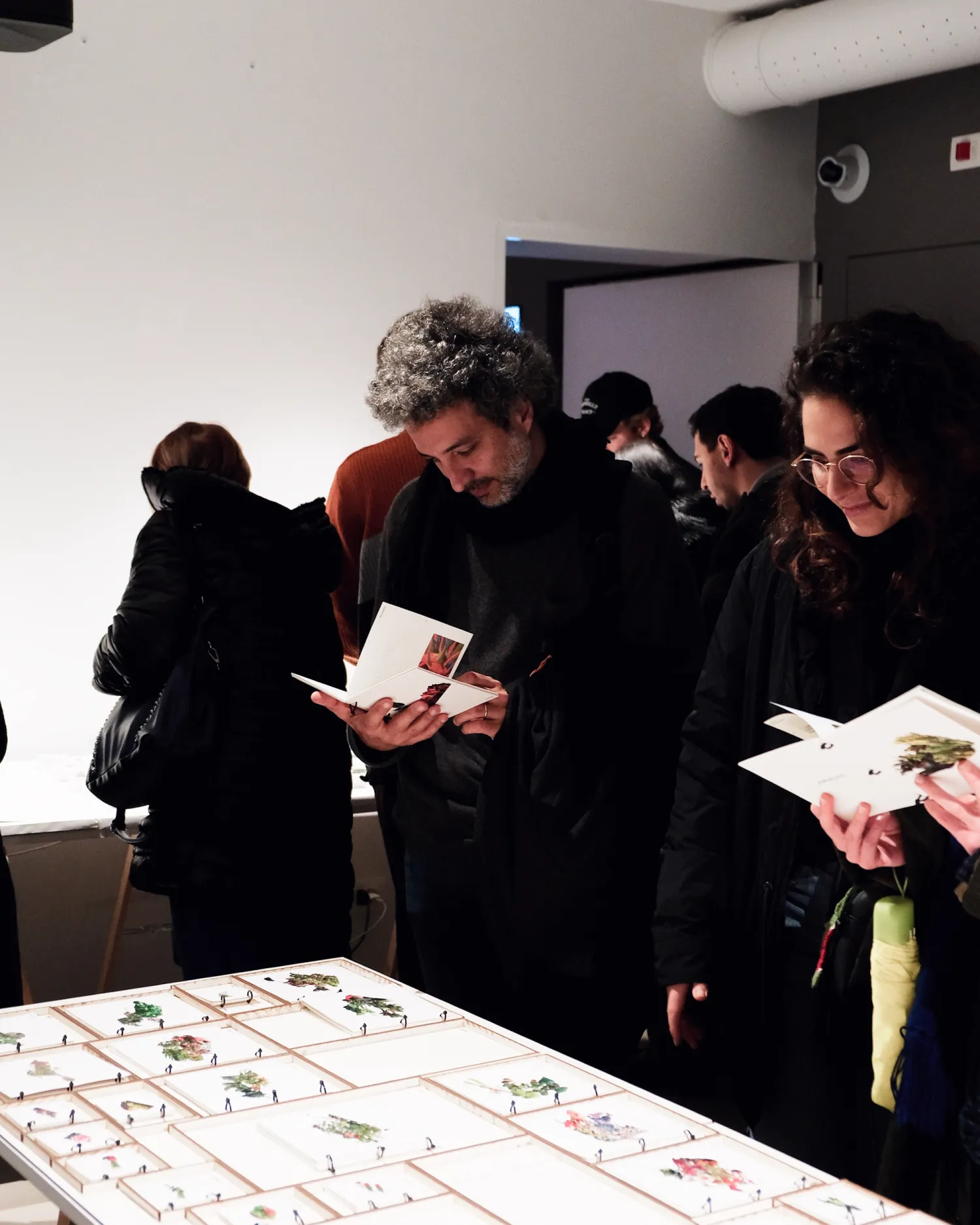
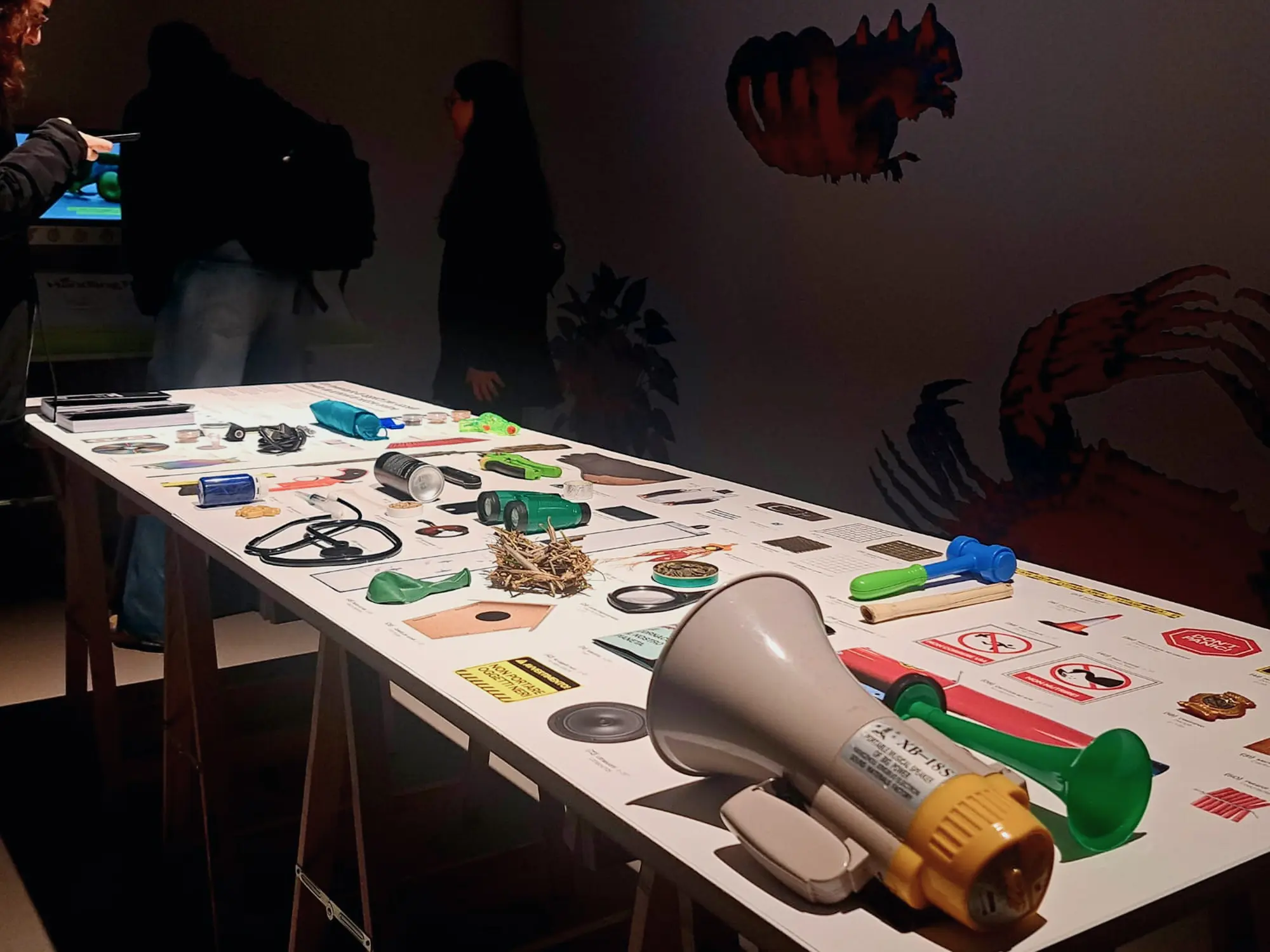
This project reflects on the coexistence between humans and seven bird species such as pigeons, starlings, gulls, cranes, herons, crows, and imperial ravens. Through analysis of 466 online news articles, 75 objects were selected that tell the story of human behaviors toward these animals, how conflicts are dealt with, and strategies adopted to manage their presence in cities. The objects will be physically displayed and accompanied by a catalog.

Tree of Heaven or Hell?
goes to the heart of the debate about Ailanthus altissima, or the Tree of Heaven. A species that, while admired for its resilience, threatens ecosystems and infrastructure, challenging our control over nature. You will explore how this plant becomes a symbol of a broader conflict between humans and the environment. An opportunity to reflect on the challenges of living with what is beyond our control.

My Belles
An installation celebrating the deep connection with indoor plants. No longer mere decorations, but true companions that enrich our homes and connections with nature. The work recreates a living ecosystem, where each plant will have its own dimension to reflect on the affection and stories that surround them.

Beyond the Squirrel
Beyond the Squirrel investigates the impact of invasive species on ecosystems. The spread of North American gray squirrels, introduced to Italy in the 1940s, is threatening the survival of red squirrels, a native species. Larger, adaptable and carrying a lethal virus, gray squirrels compete with red squirrels for food resources, altering the natural balance. The presence of an invasive species transforms not only nature, but also human social and cultural dynamics.

Digital Forest
Digital Forest explores how wildlife is transformed into digital entities through phototrap videos. These tools, once used for wildlife monitoring, have become a virtual window into an ecosystem that is constantly evolving on social media. Animals, now protagonists of a digital world, challenge our perception of nature and invite reflection on our relationship with the environment and technology.

Green Visions
Green Visions explores how green color, integrated into architectural design, transforms urban spaces, making them more appealing and livable. By analyzing renderings, the work reveals how natural elements distort the perception of buildings.

With the catalogs “Peel the Green,” in which greenery is replaced by AI-generated elements, and “Reveal the Green,” which explores the role of greenery divided into ten categories, it becomes evident how it influences architectural designs and redesigns cities.

Let Them Eat Blue Crab
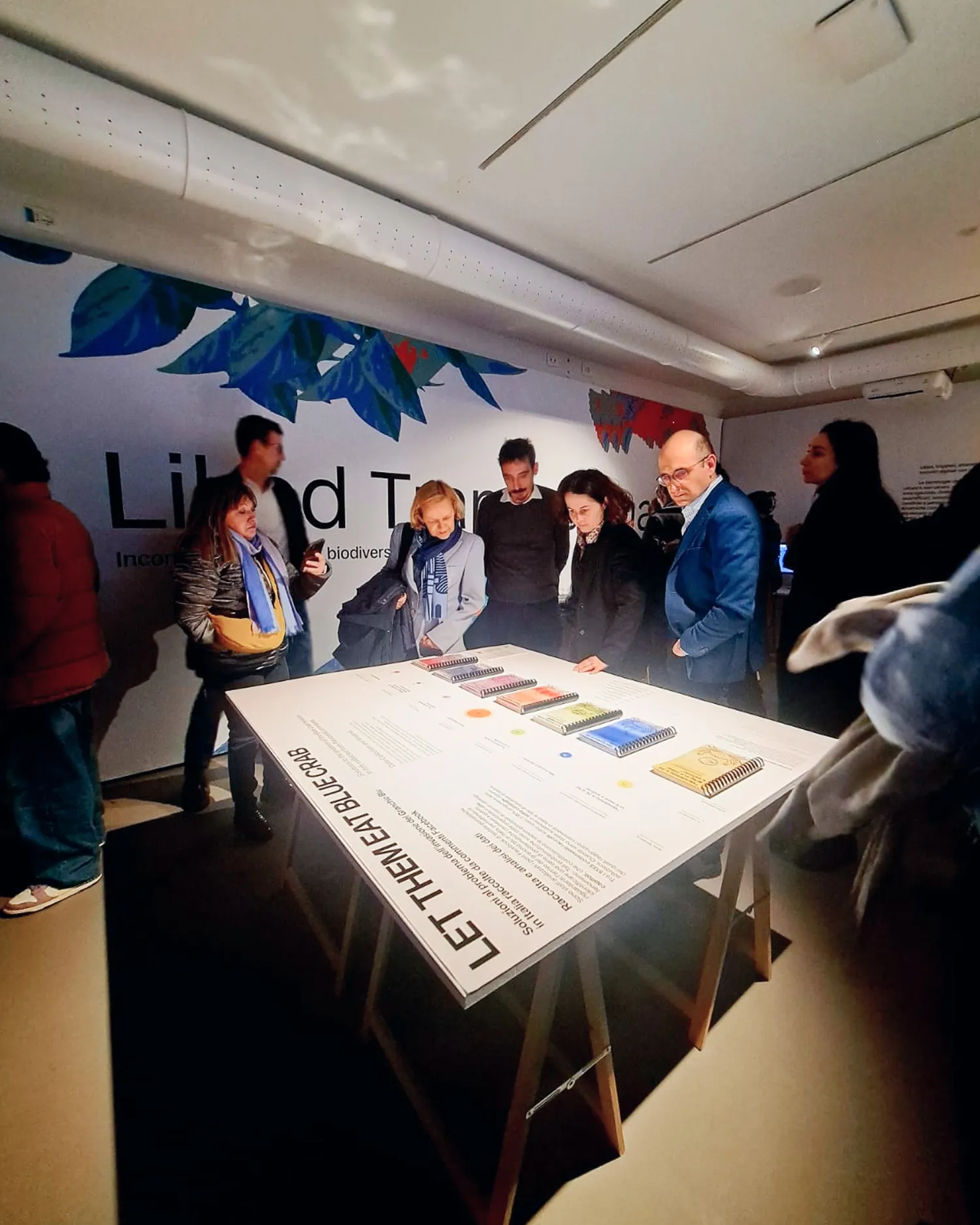
The ecological emergency related to the spread of the Blue Crab in the Mediterranean threatens biodiversity and the local economy. With a visual overview, the installation shows the devastating impact of this invasive species on seagrass beds and native shellfish, suggesting an alternative vision.

The exhibition is open until 9 March, 2025.

journey from institutional strategy to public engagement. It starts with the theoretical framework of EU projects focused on AI and rights, moves into a practical, immersive application of digital art, and concludes with the individual engagement of citizens analyzing and reflecting on the information presented.
moment of direct interaction between the public and research findings during an exhibition. A group of visitors is gathered around a display table featuring the "LET THEM EAT BLUE CRAB" section, dedicated to analytical solutions and data collected on the spread of the blue crab in Italy. Several colorful spiral-bound notebooks are laid out on the table for guests to examine, while a large graphic wall in the background echoes the event's biodiversity theme. The atmosphere suggests a phase of active learning and results sharing, where communication design transforms complex data into physical, browseable objects.

Faculty: Arianna Bellantuono, Andrea Benedetti, Ángeles Briones, Anna Cattaneo, Gabriele Colombo, Alessandra Facchin, Michele Mauri, Salvatore Zingale.


NBFC (National Biodiversity Future Center) Coordinators: Massimo Labra, Andrea Galimberti (Università degli Studi di Milano-Bicocca), Maria Chiara Pastore (Politecnico di Milano)

Authors: Davide Agostinelli, Balzhan Amangeldi, Miguel Ernesto Amaya Uchamocha, Petra Bachiorrini, Maryam Badiei, Sara Barzaghi, Beatrice Giorgia Bosco Adhara, Diletta Catti, Benedetta Crouch, Alice D'Aiuto, Margherita De Alessandri, Ana Isabel De Jesus Loreto, Alice Dezio, Martina Esposito, Laura Falanga Peri, Roberta Florian, Marta Gaggi, Federico Gajo, Eleonora Galliani, Giacomo Garetto, Alessandro Geranzani, Giada Germanò, Giulia Gnessi, Giulia Grassi, Ming Hu, Enrico Isidori, Veronica Leoni, Zimu Li, Giulia Macchini, Davide Monti, Nausicaa Naibo, Alessandra Palombelli, Roberta Parisi, Fabio Pennone, Letizia Percuoco, Lucija Pezer, Enguang Piao, Alice Polerà, Giulia Polimeno, Sara Pugliano, Anita Maria Ruggiu , Francesco Scarfone, Emanuel Simionato, Saumya Singh, Sara Stojanovic, Beatrice Tronconi, Costanza Turi, Ilaria Urgesi, Nayid Valeria Vidal Elguera, Yingying Zheng.

Visual Identity: Bianca Bauer, Benedetta Riccio
Web Project: Andrea Benedetti, Anna Cattaneo

Share on: