Fashion & Textile Living Lab
Fashion & Textile Living Lab
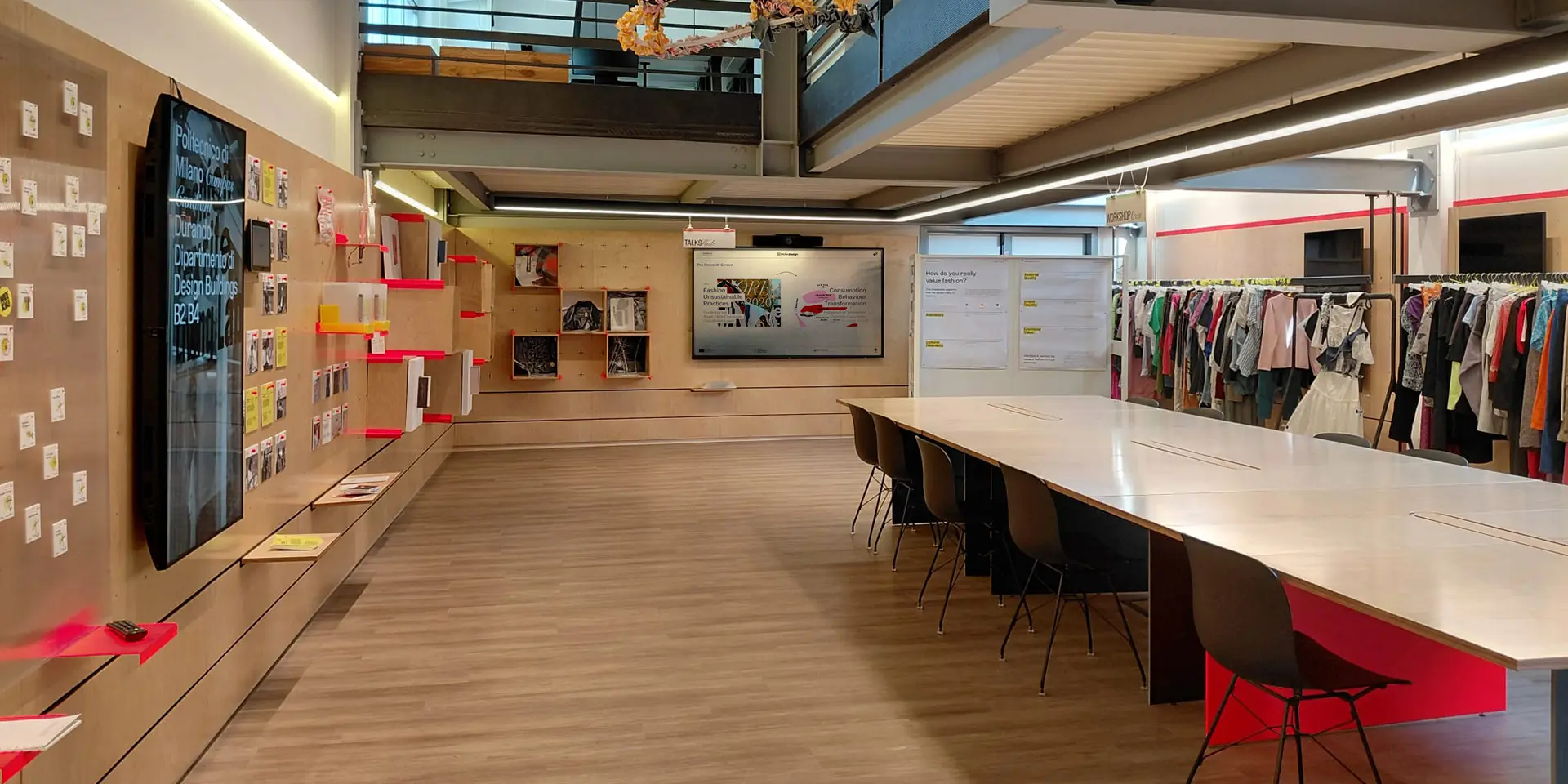
The Fashion & Textile Living Lab is a laboratory of the Department of Design at Politecnico di Milano dedicated to research, innovation and dissemination in the field of sustainability in the fashion and textile sector. Following the quadruple helix model, it brings together university, industry, public institutions and citizens, working with companies on the circular transition and with citizens on building a culture of sustainability. Its distinctive value lies in the opportunity to test innovative solutions in real-life settings, turning the community from a mere recipient into an active protagonist of innovation processes.
Objectives
The Fashion & Textile Living Lab has a twofold objective. On the one hand, it supports companies in renewing processes and products from a circular perspective. On the other, it promotes a culture of sustainability capable of shaping the everyday practices of citizens and social actors across the entire value chain. The circular transition requires not only new tools or processes, but also the capacity to question the assumptions that shape how actors in the fashion system attribute value to materials and practices. The Lab therefore pursues a form of transformative learning that goes beyond informing, and contributes to reframing these frames of meaning among participants: companies, citizens and institutions. To achieve these goals, the Lab operates across the entire textile value chain through three complementary lines of action:
_ Transformative learning and sustainability cultures. Educational and participatory formats, public initiatives and active citizenship practices that develop skills, visions and behaviours oriented towards the ecological transition in fashion consumption.
_ Collaborative circular production. Co-design and manufacturing paths that connect designers, artisans and companies along the textile value chain, integrating design, craft and industrial knowledge to reduce waste, valorise local resources, and support repair, upcycling and redesign.
_ Product–service systems for the use and post-use phases. Design of service models, sustainable retail strategies and enabling tools (toolkits, digital platforms) that extend product life and redefine the relationship between value, use and durability: care, repair, redistribution and take-back.
Activities
The Lab is a hybrid, multifunctional space that performs three distinctive roles:
_ Public demonstrator, making practices, artefacts and research outcomes visible and accessible to citizens, students and visitors.
_ Competence centre, gathering methods, tools and protocols and transferring them to companies, institutions and other laboratories.
_ Co-creation hub, hosting co-design and experimentation sessions with companies, designers, artisans and communities.
The Lab carries out these roles through a portfolio of diverse initiatives: public events, narrative devices, tool-based platforms, workshops and research activities. The initiatives are connected to one another so that learning is not confined to a single project, but builds up over time.
Origin and development
The Lab originated within the MUSA – Multilayered Urban Sustainability Action innovation ecosystem, funded by the European Union – NextGenerationEU. Since this start-up phase, it has established a permanent space at the Bovisa Campus, a stable network of partners and a portfolio of initiatives that now continues independently. The Lab thus keeps developing research, experimentation and public activities on the circular transition of fashion and textiles.
Magazine articles