
SIDE
Prototyping change through transformation design
SIDE
Prototyping change through transformation design
SIDE is a network of researchers who activate, promote, and develop new capacities to imagine and navigate transformations through design research.
The group's work is carried out in an era characterised by profound social, environmental and technological changes that are constantly redefining the ways in which people learn, collaborate, make decisions and build relationships. These transformations affect organisations, institutions, and communities, changing how people reflect together, relate to one another, and act collectively. In this context, SIDE explores the role of design not only as a problem-solving practice but also as a discipline capable of creating the conditions to imagine alternatives, make them tangible, and experiment with them together with diverse actors.
The group was established and consolidated following three years of work within a National Recovery and Resilience Plan (NRRP) project. From this experience, SIDE inherited a specific understanding of design research as a practice capable of fostering learning and capacity-building to support processes of transformation. Its research focuses on understanding how change emerges from relationships and how design can create the conditions for new possibilities to become visible, tangible, and actionable.
Rather than seeking definitive answers, SIDE aims to initiate processes of exploration and experimentation in which diverse actors can question the status quo, build shared meanings, and prototype new ways of acting together.
What characterises SIDE is not only a field of inquiry but also a way of conducting research: guided by design, oriented by shared values, and grounded in the care for relationships.
The group's projects follow a research-through-design approach, integrating design and experimentation activities with communities, organisations, and institutions with the production of knowledge on processes of transformation.
Drawing on the complementary expertise of its members, SIDE integrates established approaches to foster collaborative learning and develop capacities to navigate complex and constantly evolving contexts. These include participatory research, collaborative design, speculative design, design futures, transformative design, and systemic design. Specifically, the group aims to:
- facilitate interaction and dialogue among people, prioritising the quality of relationships over mere digital mediation;
- value direct and situated experience as a tool for reflection and the production of collective knowledge;
- use creativity, imagination, and speculative practices to explore alternative possibilities and bring still undefined futures into view;
- work with and for people, valuing the plurality of perspectives;
- embrace experimentation as an ongoing process, without claiming to provide definitive answers;
- promote reflective and self-assessment practices that foster dialogue and awareness without substituting participants' own judgement;
- explore new forms of relationship with the natural environment, seeking connections rather than separations.
SIDE applies and experiments with these principles first and foremost within the group itself, treating the group as its primary context for research and experimentation. Building on this practice, SIDE develops research activities that support groups, communities, and organisations in developing awareness through prototyping change.
To make still uncertain possibilities tangible, the group designs and develops:
- models of collaboration within competitive systems, fostering new forms of cooperation among people, organisations, institutions, and communities;
- learning pathways and the development of specific, cross-cutting, and transformative competences;
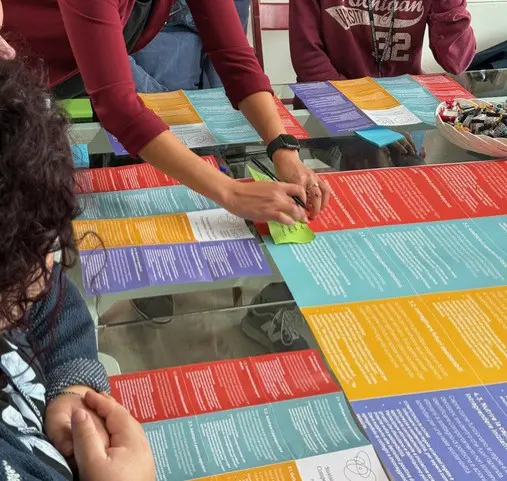
- methodologies and tools to facilitate participatory, decision-making, and organisational processes;
- action research pathways to explore change in real-world contexts;
- environments and experiences to imagine, discuss, and build preferable futures.
The group's goal is to help create the conditions that enable people, communities, and organisations to experience opportunities for learning, reflection, and collective transformation.